
Fact-checked against Transport for NSW – Opal on 2026-04-25.
Tap a card, ride a train. On the surface, public transport in Australia looks that simple. Then someone asks why the same kind of trip costs one thing in Sydney and something else in Melbourne, and the simplicity falls apart. The reason is structural, and it’s worth knowing up front: there is no single national public transport system here. There are eight – one for each state and territory – and every one of them writes its own rules.
Why public transport in Australia is state-based, not federal
Public transport sits with the states and territories, the same way public hospitals and tenancy law do. That’s how Australia’s constitution divides things up. Each jurisdiction runs its own networks, sets its own fares, manages its own concession program, and picks its own technology. Canberra chips in funding for big projects, but it doesn’t run the day-to-day services you actually use.
So a Sydney commuter and a Melbourne commuter can take near-identical trips – say an inner-suburb run into the CBD at peak hour – and pay different fares, face different concession rules, and carry completely different cards. These systems were never built to match each other. Fare parity was never the goal.
Here’s the part people get wrong, though. Each individual system is actually well laid out on its own portal. Most of the confusion comes from comparing one state against another, not from any single network being hard to follow.
Fare cards in each capital city
Every major Australian city runs a smartcard fare system. Same idea everywhere, different brand, technology, and rulebook in each place.
- Sydney and NSW – Opal card, with rules at Transport for NSW
- Melbourne and Victoria – Myki, with rules at Public Transport Victoria
- Brisbane and South-East Queensland – Go Card / Translink, with rules at Translink
- Perth and Western Australia – SmartRider, with rules at the Public Transport Authority WA
- Adelaide and South Australia – Metrocard, with rules at Adelaide Metro
- Hobart and Tasmania – Greencard, with rules at Metro Tasmania
- Canberra and ACT – MyWay+ (recently transitioned), with rules at Transport Canberra
- Darwin and NT – Tap and Ride, with rules at the NT Government transport portal
Most systems now let you tap on with a contactless bank card or your phone, on top of the physical card. It’s handy. But watch the fine print: contactless rates are sometimes higher than the smartcard rates. If you ride regularly, the smartcard tends to pay for itself.
The eight systems at a glance
Pulling the list above into one view makes the spread easier to scan. Same facts, just side by side.
| State / Territory | Main city | Smartcard | Authority |
|---|---|---|---|
| NSW | Sydney | Opal card | Transport for NSW |
| Victoria | Melbourne | Myki | Public Transport Victoria |
| Queensland | Brisbane | Go Card / Translink | Translink |
| Western Australia | Perth | SmartRider | Public Transport Authority WA |
| South Australia | Adelaide | Metrocard | Adelaide Metro |
| Tasmania | Hobart | Greencard | Metro Tasmania |
| ACT | Canberra | MyWay+ (recently transitioned) | Transport Canberra |
| Northern Territory | Darwin | Tap and Ride | NT Government transport portal |
Zones, distance, and how fares are calculated
Two main pricing models cover most of the country, with a handful of exceptions: zone-based and distance-based.
Zone-based systems – Sydney, Melbourne, Brisbane – carve the network into fare zones. Your fare depends on which zones the trip crosses, not the precise distance. Stay inside one zone and you pay less than if you cross several.
Distance-based systems work off the actual distance travelled, or the number of stations you pass. More precise, but harder to guess in advance on a route you don’t know well.
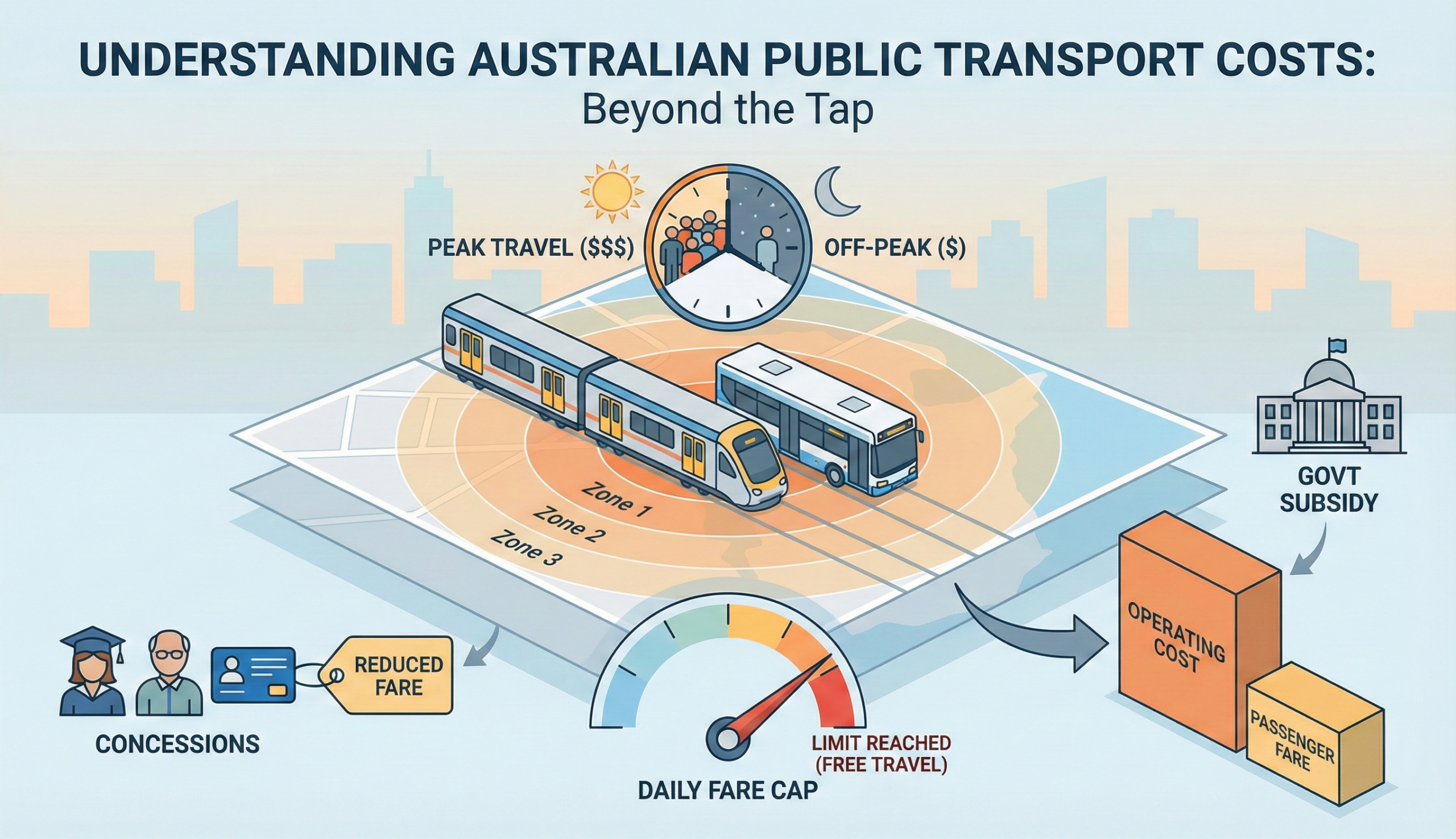
Some cities also adjust the price by time of day. Peak fares can run higher than off-peak, and the off-peak discount is there to nudge people into spreading the load across the day. In NSW, that off-peak discount on Opal is a real saving if you can shift your trip even slightly.
Then there are multi-modal trips – bus to train, ferry to bus. The smartcard usually stitches these together as one journey for fare purposes, as long as the gap between modes is short enough. The exact transfer window changes from city to city, so check your own system’s rule.
Two fare models compared
| Feature | Zone-based | Distance-based |
|---|---|---|
| What sets the fare | Which zones the trip crosses | Actual distance or stations passed |
| Examples | Sydney, Melbourne, Brisbane | Other systems using a distance model |
| Easy to predict? | Yes – stay within a zone, pay less | Harder on unfamiliar trips |
| Granularity | Lower (priced in zone bands) | Higher (priced per distance) |
Daily, weekly, and weekend caps
Most capital-city systems put a ceiling on what you can be charged, so frequent travellers aren’t paying per-trip fares all day long. The caps usually come in three flavours:
- Daily cap – once your fares for the day hit the cap, the rest of that day’s travel is free
- Weekly cap – once your fares for the week hit the cap, the rest of that week’s travel is free
- Weekend or off-peak cap – some systems set a lower combined weekend cap to encourage weekend travel
Caps are the reason regular commuting often costs less than the per-trip price would suggest. Take a five-day-a-week commuter who hits the weekly cap on Wednesday – they ride free for the rest of the week. Each system publishes its cap structure on its own fare page, so the numbers are easy to find.
One catch worth remembering: caps almost always stay inside a single fare system. Travel across two states in the same week and you generally can’t pool those fares toward one cap. The systems don’t share that data.
Illustrative example: how a weekly cap plays out
Illustrative only. Imagine a commuter who travels five days a week and reaches the weekly cap on Wednesday. From Thursday and Friday onward, travel within that same system for the rest of the week costs nothing extra, because the cap has already been met. No dollar figures are used here – the actual cap amount is set by each city and published on its fare page.
Concessions – students, pensioners, and other categories
Every state runs its own concession scheme. The fares are usually around half the standard adult rate, and the categories that commonly qualify are:
- Students enrolled in approved educational institutions
- Pensioners with appropriate cards
- Healthcare card holders
- Senior citizens (with age and residency requirements)
- Children under defined ages (often under 16, sometimes free)
- Veterans and other defined categories
The discount doesn’t switch on by itself. You normally have to register your concession status with the smartcard system first. Holding a healthcare card isn’t enough on its own – the card has to be linked to your transport account, with proof of eligibility lodged with the transport authority.
If you’re on a Centrelink payment, we cover which cards make you eligible in our Centrelink eligibility article. Those cards are issued under rules administered by Services Australia.
Regional transport and the gap
Step outside the capital cities and public transport thins out fast. Regional services do exist – country trains, regional bus networks, intercity coaches – but the frequency, the coverage, and how well fares integrate all look noticeably different from the capital networks.
What that means for your household budget is simple enough. Regional residents lean on private vehicles for most trips, which moves a real chunk of spending out of public-transport fares and into fuel, registration, and insurance. The ABS Consumer Price Index transport component tracks those private-vehicle costs right alongside public-transport fares.
This divide – capital-city households leaning on public transport, regional households leaning on the car – is a genuine factor in how cost-of-living pressure lands across the country. It also feeds into the wider inflation picture we unpack in our inflation explainer.
Frequently asked questions
Why are public transport fares different between Australian cities?
Public transport in Australia is run by state and territory governments, not the federal government. Each system sets its own fare structure, zones, caps, and concessions. Sydney uses Opal; Melbourne uses Myki; Brisbane uses Go Card / Translink. The systems are independent, so fares between cities differ even for similar trip distances.
How do fare caps work in Australia?
Most Australian capital city public transport systems include daily, weekly, and sometimes weekend fare caps. Once a passenger’s fares hit the cap in the relevant period, further travel within that period is free. Caps protect frequent users from paying per-trip fares all day. The exact cap amounts and periods vary by city.
Do students and pensioners get cheaper public transport?
Yes, in most Australian cities. Concession fares apply to eligible students, pensioners, healthcare card holders, and some other categories. Each state’s transport authority sets the eligibility rules and the discount levels. Concession status usually has to be registered with the local fare card before the discount applies.
The fare-related cost most public transport users miss
The cost people underestimate isn’t a single trip. It’s the slow, long-run gap between paying with a contactless bank card and using the dedicated smartcard. In several states, contactless adult fares run higher than smartcard adult fares, and concession rates are usually only available through the smartcard at all. Stretch that over a year of regular travel and the difference comes to a lot more than what it costs to register the smartcard in the first place.
The second thing that catches people out: concessions never apply on their own. A pensioner who taps on with a contactless card, without registering their pension status to a smartcard, pays full adult fares – even though they qualify for the concession rate. The system only ever rewards positive registration. Leave it alone and the default is the higher fare.
So if you ride regularly in any Australian city, the practical move is short. Register the local smartcard, link any concession status you’re entitled to, and read the cap structure so you can plan around it. None of it takes much time, and together those three steps explain most of the gap between what regular riders actually pay and what the per-trip fare makes it look like.
What matters most, in order
- Register the local smartcard – in several states, smartcard adult fares are lower than contactless adult fares, so this is where most of the long-run saving sits.
- Link any concession status you’re entitled to – concessions are roughly half the standard adult rate, but they don’t apply until your eligibility is registered and proof is lodged with the transport authority.
- Read the cap structure – daily, weekly, and weekend caps mean further travel is free once you hit the cap, so knowing yours lets you plan around it.
- Check the off-peak and transfer rules – off-peak discounts (a real saving on Opal in NSW) and short-window multi-modal transfers can lower the cost of trips you already take.