
Centrelink is one of those systems most Australians know exists, but very few truly understand — at least not until they find themselves needing it.
For some, work slows down. For others, a contract ends, study begins, illness interrupts plans, or family responsibilities suddenly take priority. And then, often without warning, Centrelink moves from an abstract idea to a very real presence in daily life.
This explanation is written for that moment. Not as a rulebook. Not as a checklist. But as a calm, grounded look at how Centrelink actually works in practice — what the system is designed to do, how decisions are made, and why so many people feel confused or overwhelmed by it.
What Centrelink really is
Centrelink is not a charity, and it is not a separate welfare organisation operating on its own terms.
It is part of the Australian government, delivered through Services Australia, and its role is administrative rather than discretionary.
In simple terms, Centrelink exists to deliver government payments to people whose income is low, unstable, or temporarily unavailable — according to rules set in law. It does not decide who “deserves” help. It assesses whether someone’s circumstances fit the conditions of a particular payment at a particular time.
That distinction matters. Many frustrations with Centrelink come from expecting empathy from a system that is built primarily for consistency and scale.
The idea behind Centrelink payments
Centrelink payments are often described casually as “free money,” but that framing doesn’t match how the system works.
Payments are:
- income-tested
- asset-tested
- often activity-tested
- reviewed regularly
The system is built around three core assumptions:
- People’s circumstances change
- Government support should adjust as they do
- People who can work should be moving, at least gradually, toward work
This is why Centrelink asks so many questions and requests frequent updates. The goal is calibration, not scrutiny — keeping payments aligned with current circumstances rather than fixed indefinitely.
Where frustration arises is in the mismatch between human life, which is messy and unpredictable, and administrative systems, which require clean inputs and regular confirmation.
The broad types of Centrelink payments
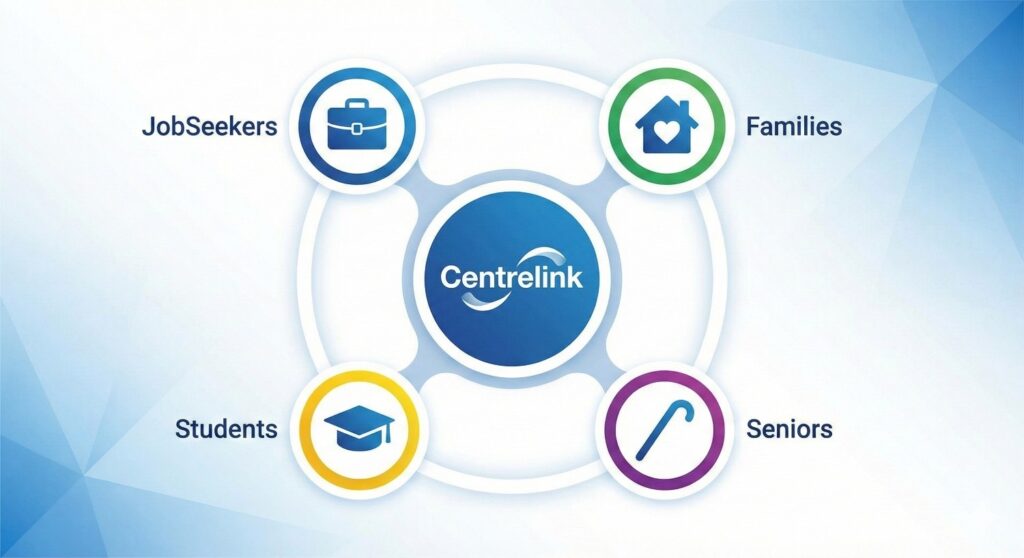
Centrelink administers many different payments, but most fall into a few broad categories:
- Income support for people with little or no income
- Payments for families raising children
- Student and youth payments for people studying or training
- Disability and carer payments for long-term health or care needs
Each payment has its own rules, but they all rely on the same underlying logic:
- how much income you have
- what assets you hold
- your living and family situation
- your capacity to work
Once that logic is understood, the specific names of payments become less intimidating.
Income tests and why small changes matter
One of the biggest surprises for new Centrelink users is how sensitive payments are to income changes.
Centrelink looks not just at whether you earn money, but:
- how much you earn
- how often you earn it
- where it comes from
- whether it is ongoing or temporary
As income increases, payments usually taper rather than stop suddenly. This isn’t a penalty — it’s how the system avoids sharp cut-offs. However, because income is generally reported fortnightly, timing matters.
Late or incorrect reporting can pause payments or create adjustments later. Many overpayments begin here, not because of intent, but because reporting didn’t line up perfectly with reality.
Asset tests: not just about cash
Assets are often more confusing than income.
Centrelink is not only asking how much money you have right now. It is asking whether you have resources that could reasonably support you if income stopped.
Assets can include:
- savings
- investments
- vehicles
- property other than a main home in many cases
- sometimes superannuation, depending on age
Assets don’t always remove eligibility, but they can reduce payments. Two people with the same income can receive very different outcomes based on their fallback resources.
This is not moral judgment. It’s prioritisation within a limited public system.
Reporting becomes central once payments start
Once someone is receiving Centrelink support, reporting becomes their main ongoing responsibility.
This usually involves:
- declaring income every fortnight
- updating changes in work, address, relationships, or major financial circumstances
Missed reports can suspend payments. Incorrect reports can lead to debts — even when mistakes are accidental.
The system assumes responsibility sits with the individual. There is little tolerance for “I didn’t realise,” which is why Centrelink often feels stressful rather than supportive.
Mutual obligations and conditional support
Many Centrelink payments come with mutual obligations.
This means support is provided on the condition that certain activities are undertaken, such as job searching, attending appointments, training, or other approved actions.
Requirements vary widely depending on age, health, parenting responsibilities, and local employment conditions. What remains consistent is the principle: ongoing engagement matters.
Partial non-compliance can affect payments, even if circumstances feel understandable on a human level.
Reassessments are normal, not exceptional
Centrelink payments are not set once and left alone.
They are reassessed when:
- income changes
- assets change
- relationships change
- living arrangements change
- policy settings change
Some reviews happen automatically. Others happen later, sometimes well after the original change occurred. This is why records and consistency matter more than many people expect.
Reassessment does not mean something was wrong before. It reflects the system’s ongoing adjustment model.
How Centrelink debts usually arise
Centrelink debts are one of the most feared aspects of the system.
In reality, most debts arise from:
- delayed reporting
- incorrect income estimates
- data mismatches between systems
A debt means the system believes more money was paid than should have been at the time. It does not automatically imply wrongdoing.
Many debts can be reviewed, explained, adjusted, or repaid gradually. The situations that escalate are usually those left unaddressed, not those questioned early.
The emotional weight of Centrelink
What’s often missing from official explanations is how Centrelink feels.
People commonly experience:
- guilt about needing help
- anxiety about compliance
- fear of making mistakes
- frustration with slow or unclear processes
None of this is unusual. Centrelink is designed to operate at scale, not to provide emotional reassurance. That gap is real, and it affects how people experience the system even when support exists.
The real takeaway
Centrelink is not a personal judgment and not a moral verdict.
It is a rule-based system designed to adjust support based on income, assets, capacity, and circumstance — repeatedly and sometimes bluntly.
When people struggle with Centrelink, it is rarely because they are careless. It is usually because the system is complex, rigid, and poorly explained in human terms.
Approaching Centrelink as a system to understand, rather than something to fear, doesn’t remove every frustration — but it does make the experience noticeably more manageable.