
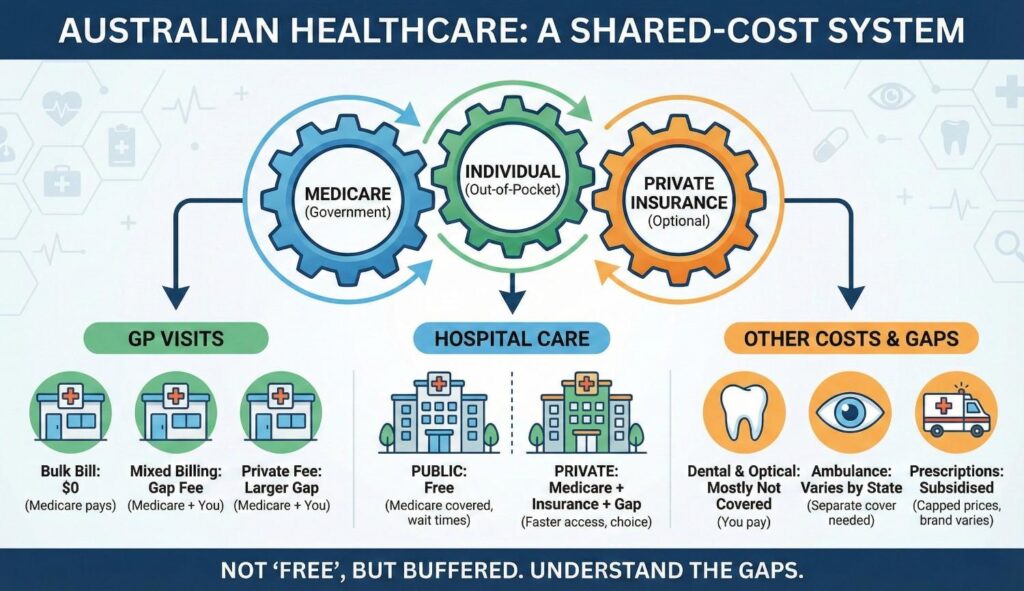
Healthcare costs in Australia confuse people not because they are high or low, but because they are uneven.
Some people pay nothing for years. Others receive bills that feel unexpected, disproportionate, or poorly explained. Both experiences can happen inside the same system.
This confusion isn’t accidental. Australia’s healthcare system is designed to split costs, hide some of them, surface others, and shift responsibility depending on context.
Understanding healthcare costs in Australia isn’t about memorising what is “covered.” It’s about understanding how the system decides when cost matters — and when it doesn’t.
Healthcare Costs Are Intentionally Fragmented
Australia does not run a single, unified healthcare pricing system.
Instead, healthcare costs are spread across public funding, individual payment, and optional private coverage. Each layer absorbs different types of risk.
The result is a system where no single bill tells the full story.
Costs appear in fragments: small gaps, occasional invoices, pharmacy payments, insurance premiums, and services that sit completely outside public coverage.
Fragmentation reduces visible shock — but increases long-term confusion.
The Role of the Public System
The public healthcare system exists to absorb the highest-risk and least predictable health costs.
Emergency care, essential treatment, and hospital services are prioritised based on need, not ability to pay.
This is why serious illness does not usually result in immediate financial collapse.
But the public system is not designed to remove all cost — only to cap risk where failure would be catastrophic.
Why “Free Healthcare” Is the Wrong Mental Model
Healthcare in Australia is not free. It is buffered.
The system decides which costs should be socialised and which should remain personal.
Routine services, choice, speed, and continuity are areas where individuals are expected to contribute.
This trade-off is structural, not accidental. It preserves public capacity by limiting what the system promises universally.
Why Two People Pay Different Amounts for Similar Care
Cost variation is one of the most misunderstood features of Australian healthcare.
Providers set prices independently. Public rebates are fixed. Insurance coverage varies. Geography matters.
The system does not aim for price uniformity. It aims for access stability.
That choice protects availability — but sacrifices predictability.
Where Costs Become Visible
Healthcare costs are most visible at the edges of the system.
Outside emergency care. Outside hospital wards. Outside strictly defined public coverage.
This is where people encounter gaps, invoices, and uncertainty — not because the system failed, but because this is where it expects private contribution.
Private Health Insurance as a Pressure Valve
Private health insurance does not replace the public system.
It exists to redirect demand, reduce waiting pressure, and give individuals control over timing and provider choice.
It does not eliminate cost. It reshapes when and how costs appear.
Insurance absorbs some risk — but introduces its own complexity.
Services That Sit Outside the Core System
Some healthcare services exist largely outside public protection.
Dental, optical, allied health, and long-term therapies operate in a more market-driven space.
These areas reflect a deliberate boundary: the system prioritises life-saving and essential care over quality-of-life optimisation.
This boundary is where many people feel the system “stops helping.”
Why Healthcare Costs Feel Unpredictable
Healthcare costs feel unpredictable because they are event-based, not regular.
You don’t experience them weekly like rent or groceries. They appear suddenly, often during stress, illness, or urgency.
That timing magnifies emotional impact — even when the actual amounts are moderate.
Cost Visibility Is Not the Same as Cost Size
Some of the largest healthcare costs are invisible because they are absorbed publicly.
Smaller costs feel heavier because they are visible, itemised, and personal.
This visibility bias is why healthcare often feels more expensive than it is relative to risk.
The Trade-Off the System Makes
Australia’s healthcare system trades simplicity for resilience.
It limits financial collapse during major health events — but accepts everyday complexity and uneven pricing.
The confusion people experience is not a flaw. It is the cost of a system that prioritises access over clarity.
The Real Takeaway
Healthcare costs in Australia are not designed to be intuitive.
They are designed to distribute risk, protect capacity, and prevent worst-case outcomes.
When people expect a single rule, a single price, or a single explanation, frustration follows.
When healthcare is understood as a layered system — not a service menu — the unevenness starts to make structural sense, even if it remains emotionally difficult.