
Fact-checked against My Aged Care — Financial information on 2026-04-25.
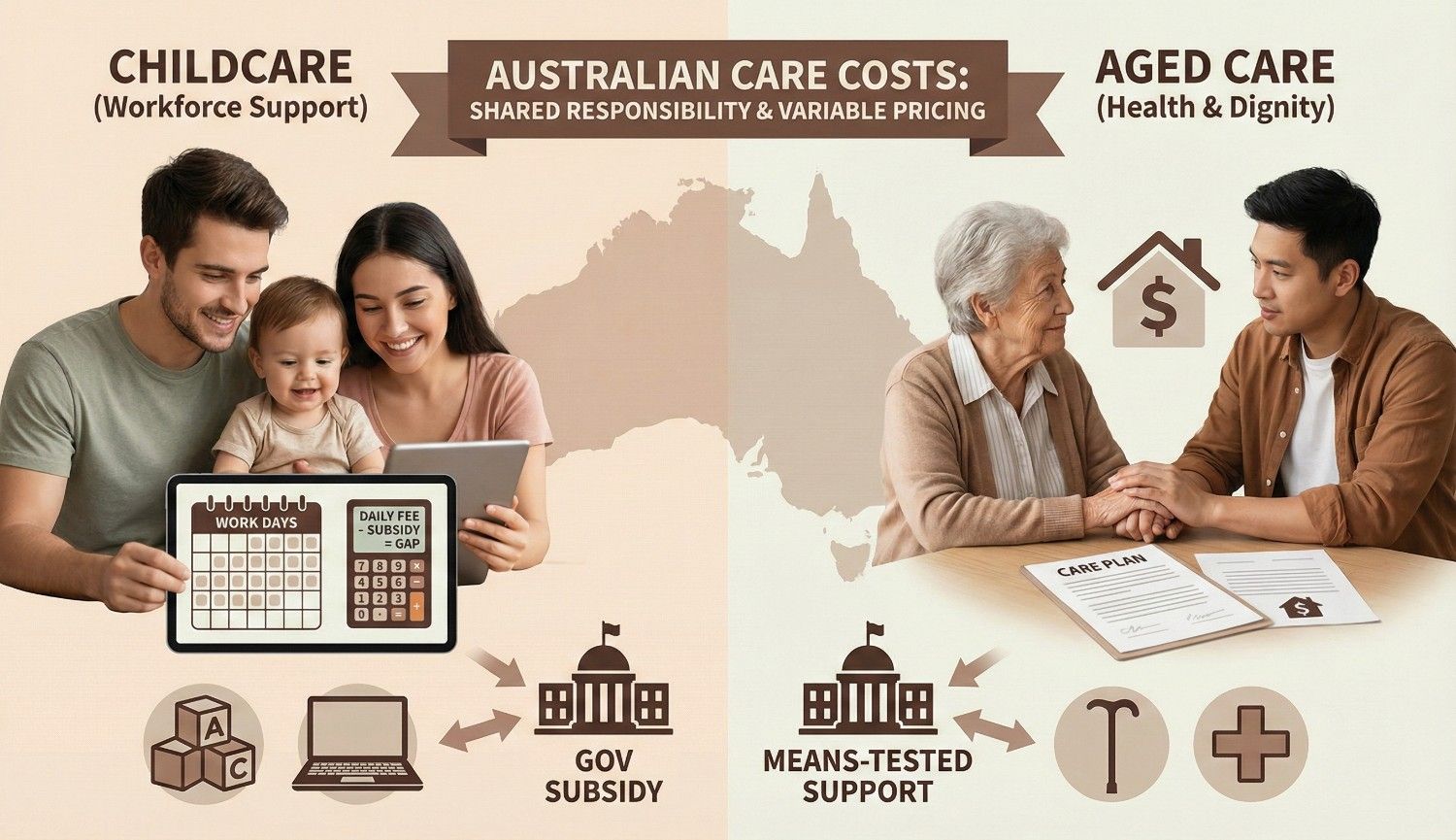
Childcare and aged care are the two costs that catch Australian families off guard. Not because nobody warned them – because the published subsidies look generous on paper, then the bill arrives and the gap is wider than anyone expected. The system is meant to make both affordable. In reality, what you pay out of pocket once means tests and fee caps are applied sits a long way below the sticker price, but also a long way above zero. And here’s the part most people miss: even though the two systems serve completely different groups, they’re built the same way underneath.
Why these two costs feel disproportionately heavy in Australia
Both aged care and childcare run on the same trick. There’s a published fee that looks scary, and then there’s what you actually pay – and the second number depends on a multi-step subsidy and means-test calculation that spits out wildly different answers for families who look almost identical on paper. Published childcare fees and aged-care daily costs sit at one level. The effective outlay for a family or a resident sits at another. That gap between the two is the whole story.
There’s a second thing they share: these costs don’t hit once, they stack up over years. Childcare typically runs 4 to 6 years per child. Aged care can run anywhere from 1 to 10+ years. A weekly cost you can shrug off for a couple of months becomes a different beast across a full year – or a full life stage.
And both are means-tested, which trips people up. More financial resources means a bigger contribution. Someone sitting on savings or a healthy super balance can pay more in aged-care fees than someone on a similar income with fewer assets. That’s not a glitch in the system. It’s the design working as intended.
How the Child Care Subsidy actually works
The Child Care Subsidy (CCS) is the main federal subsidy for early childhood education and care in Australia. Services Australia runs it, and it’s paid straight to your approved childcare provider, so the fee is already lower by the time it reaches you. The CCS page on Services Australia sets out the current rules.
Three things decide your CCS rate:
- Family income – the more you earn, the lower your subsidy percentage, on a sliding scale
- Activity hours – work, study, training, volunteering or looking for work; more activity unlocks more subsidised care hours per fortnight
- Type of care – long day care, family day care, in-home care and outside-school-hours care each have their own published hourly rate cap
The subsidy is a percentage of whichever is lower: the actual fee or the hourly rate cap. You pay the gap. Higher-income families land on lower percentages, lower-income families on higher ones, and there’s a base built in so that even families at the top get some subsidy up to a defined ceiling.
The federal Department of Education’s early childhood portal covers the broader policy framework.
Why CCS doesn’t always close the gap
The CCS is meant to make childcare affordable. The reality is that the gap between the subsidy and the actual centre fee is exactly where families feel the squeeze. Two things drive that gap:
Centre fees often sit above the hourly rate cap. Remember, the CCS percentage applies to the lower of the actual fee or the cap. So if your centre charges above the cap, the subsidy doesn’t stretch over the difference. You pay the percentage gap on the cap, then the entire above-cap amount on top.
The activity test cuts your subsidised hours. How many subsidised hours you get per fortnight comes down to the activity hours of the lower-earning partner – or the only earner, if there’s one. Low or zero activity means fewer subsidised hours, which can leave you paying full unsubsidised fees for care you genuinely need.
Put those two together and you get the result that surprises people: two families on similar incomes, with similar care needs, can end up with very different out-of-pocket costs. It all hinges on whether their centre sits at, near or above the hourly cap, and whether their work or study hours qualify for the subsidy in the first place.
The aged care cost framework
Aged care in Australia is funded mostly by the federal government, with the resident chipping in a share based on means tests. If you want to understand the cost structure, start at My Aged Care’s financial information page – that’s the federal portal for cost details, calculators and the individual fee components.
There are two streams. Home care covers supports delivered to someone in their own home. Residential aged care covers accommodation and care inside a facility. Each has its own cost structure, both are means-tested, and both come with annual and lifetime caps that exist to stop costs running away on you.
The Department of Health and Aged Care’s aged care portal lays out the policy framework and the recent changes. My Aged Care is the operational side – assessments, eligibility checks and fee calculations all happen there.
The fees inside residential aged care
Residential aged care fees come in several parts, and most residents will pay most of them to one degree or another. Here’s how the pieces fit together.
| Fee component | What it covers | Means-tested? |
|---|---|---|
| Basic daily fee | Everyday living – meals, cleaning, laundry, utilities. Set as a percentage of the basic Age Pension and indexed periodically. | No – applies to all residents |
| Accommodation contribution or payment | The room itself. Paid as a Refundable Accommodation Deposit (lump sum), a Daily Accommodation Payment (ongoing daily fee), or a mix of both. | Yes – more assets, more you pay |
| Means-tested care fee | A contribution toward the cost of care. Has annual and lifetime caps so it can’t run away over a long stay. | Yes – based on income and assets |
| Additional services fees | Optional extras – premium meals, extra services, single-room upgrades. Not subsidised, and they vary a lot between facilities. | No – only if you opt in |
Basic daily fee
This is the one everyone pays. It covers everyday living costs – meals, cleaning, laundry, utilities – and it’s set as a percentage of the basic Age Pension, indexed periodically.
Accommodation contributions or payments
This is the cost of the room. It’s means-tested, so residents with more assets pay more and those with fewer assets are subsidised. You can pay it as a Refundable Accommodation Deposit (a lump sum), a Daily Accommodation Payment (an ongoing daily fee), or some combination of the two.
Means-tested care fee
This is a contribution toward the actual cost of care, worked out from your income and assets. There are annual and lifetime caps in place so the fee can’t keep climbing indefinitely over a long stay.
Additional services fees
These are the optional extras – premium meals, additional services, single-room upgrades – and you only pay them if you choose them. They aren’t subsidised and they can vary a fair bit from one facility to the next.
Add it all up and that’s what residents and their families actually hand over. The total can be substantial, and because several of the components are means-tested, a resident with more financial resources pays a good deal more than one with less.
Home care versus residential – cost differences
Home care brings aged-care services to a person in their own home. It’s funded differently from residential care: it runs on Home Care Packages, set at one of four levels (1 to 4), with the higher levels carrying more weekly funding for services.
What you typically pay for home care:
- A basic fee – a small daily amount
- An income-tested care fee – for higher-income recipients
- Out-of-pocket charges for any services that go beyond what the package covers
For a lot of older Australians and their families, the real question isn’t “home care or residential”. It’s “home care now, residential later”. The system is built to support that progression as care needs grow. Home care can keep someone at home for years, and residential care steps in once those needs outgrow what home support can manage.
Before you settle on a stream, it’s worth weighing a few things in order. Here’s the sequence families tell us actually matters:
- Get the assessment done early. Eligibility, the right Home Care Package level, and residential need all flow from this. Nothing else is reliable until it’s done.
- Run your own numbers, not the averages. Means-tested fees mean your figure can be nothing like the headline figure – so use the federal calculators on your actual situation.
- Plan for the long horizon. A cost that’s fine for a month can be unmanageable across years. Model the multi-year figure, not the monthly one.
- Sort the payment structure last. Once you know the fees, decide how to fund them – lump sum, daily payment, or a mix – ideally with advice, because it interacts with super, the Age Pension and home equity.
The interaction between aged care and broader retirement planning is covered in our retirement systems explainer. The eligibility for related Centrelink supports is in the Centrelink eligibility article.
Childcare and aged care side by side
The two systems serve opposite ends of life, but their cost machinery rhymes. Here’s how the moving parts line up.
| Childcare (CCS) | Aged care | |
|---|---|---|
| Main subsidy/funding | Child Care Subsidy, paid to approved providers | Federal funding, via Home Care Packages or residential subsidies |
| Means-tested? | Yes – on family income | Yes – on income and assets |
| Fee caps involved | Hourly rate caps per care type | Annual and lifetime caps on the means-tested care fee |
| Typical duration | 4 to 6 years per child | 1 to 10+ years |
| Federal portal | Services Australia | My Aged Care |
Different populations, same underlying logic: a published price, a means test, a set of caps, and a real cost that only shows up once you run your own circumstances through the calculator.
Frequently asked questions
How does the Child Care Subsidy work in Australia?
The Child Care Subsidy (CCS) is a federal payment paid directly to approved childcare providers to reduce the cost for eligible families. The amount depends on family income, hours of approved activity (work, study, volunteering), and the type of care. Higher-income families get a smaller subsidy percentage; lower-income families get up to a high percentage of the published fee.
Are aged care costs means-tested in Australia?
Yes. Aged care costs in Australia have multiple components, several of which are means-tested. The basic daily fee, accommodation contributions, and means-tested care fees all depend on income and assets. The system is designed so that people with more financial resources contribute more, while those with fewer resources are subsidised more heavily.
What is the difference between home care and residential aged care in cost terms?
Home care provides supports and services delivered in a person’s own home, usually through Home Care Packages. Residential aged care provides accommodation, care, and services in a residential facility. Costs are structured differently: home care uses package levels with a basic fee plus income-tested contributions; residential care has accommodation costs plus daily fees plus means-tested fees.
The single piece of advice both groups consistently say
Ask families dealing with childcare costs and older Australians working through aged-care costs, and you’ll hear the same first piece of advice: get a proper assessment of your situation early, and use the federal calculators to model your own case before you commit to anything. Both systems publish estimators – the CCS calculator on Services Australia, the fee calculators on My Aged Care – and the numbers they hand back are usually nothing like the generic averages floating around.
The second piece of advice is identical on both sides too: factor in the long horizon. Childcare runs for years. Aged care can run for years. The cost looks manageable in any single month and overwhelming across a multi-year stretch, and that gap is where most of the family financial stress shows up.
So the practical move is simple enough. Use the federal calculators – CCS on Services Australia, the fee calculators on My Aged Care – model the multi-year cost, and adjust while you still have room to. For aged care in particular, a financial planner who specialises in aged-care fee planning often earns their fee several times over, because those means-tested structures interact with super, the Age Pension and home equity in ways that genuinely change the best way to pay.