
Inflation is often discussed as a number, but lived as a feeling.
People hear percentages on the news, statements from central banks, and reassurances from governments. Yet none of that explains the quiet moment when everyday expenses start taking more space than they used to — without any single dramatic change.
Inflation rarely announces itself loudly. It settles in gradually.
Shopping habits stay the same, routines don’t change, but somehow the same income covers less. That slow shift is what most people mean when they say “things are getting expensive.”
This explanation looks at inflation through that everyday lens. Not formulas. Not forecasts. Just how rising prices interact with daily living costs, why the impact feels uneven, and why personal experience often clashes with official averages.
Inflation as a Daily Experience
In practical terms, inflation is not about everything becoming expensive at once. It’s about erosion.
Over time, money loses some of its ability to buy the same things. The change is incremental. Small enough to ignore in the moment. Large enough to feel unavoidable when accumulated.
Because different prices move at different speeds, inflation never feels evenly spread. Some costs jump quickly. Others barely move for years.
This unevenness is why inflation feels personal rather than mathematical.
Why Essentials Absorb Inflation First
Living costs are usually where inflation becomes visible earliest.
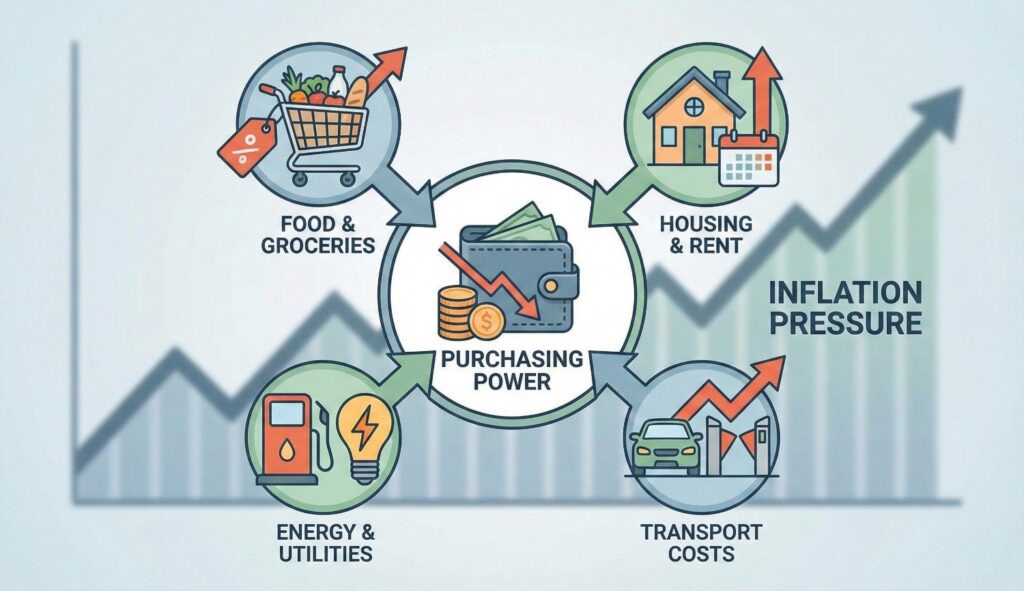
Essentials such as housing, food, energy, transport, and healthcare allow very little flexibility. When prices rise here, households feel it immediately.
Optional spending can be delayed. Essentials cannot.
That lack of choice is what gives inflation its pressure.
Food Costs: Repetition Creates Impact
Food is one of the most noticeable inflation channels.
Grocery purchases happen often. Price increases are small but frequent. Substituting items isn’t always practical.
One item increasing slightly doesn’t register strongly. A weekly routine becoming consistently more expensive does.
Because food takes up a larger share of income for lower-income households, inflation here feels especially uneven.
Housing: Where Inflation Concentrates
Housing magnifies inflation more than almost any other expense.
Rising rents, changing interest rates, higher maintenance costs, and increasing service charges all push in the same direction.
For renters, the impact often arrives suddenly at renewal. For owners, it appears gradually through repayments and upkeep.
Because housing already consumes a significant portion of income, even small increases feel heavy.
Energy and Utilities: Costs Without Escape
Energy prices tend to fluctuate more than most living costs.
Electricity, gas, and fuel are influenced by global supply, infrastructure, policy, and demand patterns far outside household control.
While usage can be adjusted slightly, access cannot be removed. That rigidity makes energy inflation feel stressful rather than manageable.
Transport: Inflation That Spreads
Transport costs carry inflation through the economy.
Fuel, fares, vehicle maintenance, and logistics costs rise together. Even people who don’t drive are affected because goods and services still need to move.
Transport inflation rarely stays isolated. It feeds into food prices, services, and everyday goods.
Why Income Adjustments Lag
One of the hardest aspects of inflation is timing.
Prices respond quickly to changing conditions. Wages usually adjust slowly, often annually or through job changes.
That delay creates a gap where costs rise first and income follows later — if it follows at all.
This gap is where inflation feels most uncomfortable.
Unequal Impact Across Households
Inflation doesn’t affect everyone equally.
Households spending a larger share of income on essentials feel inflation more intensely. Those with limited savings or fixed incomes have fewer options to adapt.
Others may adjust more easily through flexibility, buffers, or timing.
That difference is why inflation feels unfair even when averages appear moderate.
Why Official Numbers Feel Disconnected
Headline inflation rates represent averages across many categories.
Essentials often rise faster than discretionary items. Frequently purchased items feel more noticeable than occasional expenses.
Each household experiences its own version of inflation, shaped by how money is actually spent.
Quiet Adjustments People Make
As costs rise, behaviour shifts — usually without announcement.
Discretionary spending shrinks. Purchases are postponed. Living arrangements change. Extra work is considered.
These adjustments reduce financial strain, but they also reshape lifestyle and wellbeing.
Why Inflation Takes Time to Ease
Inflation is driven by interconnected systems.
Supply chains, energy markets, labour availability, policy responses, and consumer behaviour all interact. Some forces respond quickly. Others take years.
Efforts to slow inflation often affect growth and employment, which is why responses are cautious rather than immediate.
The Psychological Layer
Rising costs influence confidence as much as finances.
People become more cautious, more risk-averse, and more focused on short-term stability. That mindset can persist even after inflation slows.
What Inflation Is Not
Inflation does not mean prices rise endlessly at the same pace.
It does not imply sudden collapse or permanent loss of living standards.
Inflation moves in cycles. The challenge lies in navigating through it, not assuming it never changes.
The Real Takeaway
Inflation affects living costs because the systems that support daily life are tightly connected.
When those systems absorb pressure, households feel it immediately — even when the cause feels distant or abstract.
Understanding why essentials react first, why income lags behind prices, and why personal experience differs from averages doesn’t remove the pressure.
But it replaces confusion with clarity — and clarity matters when margins are tight.