
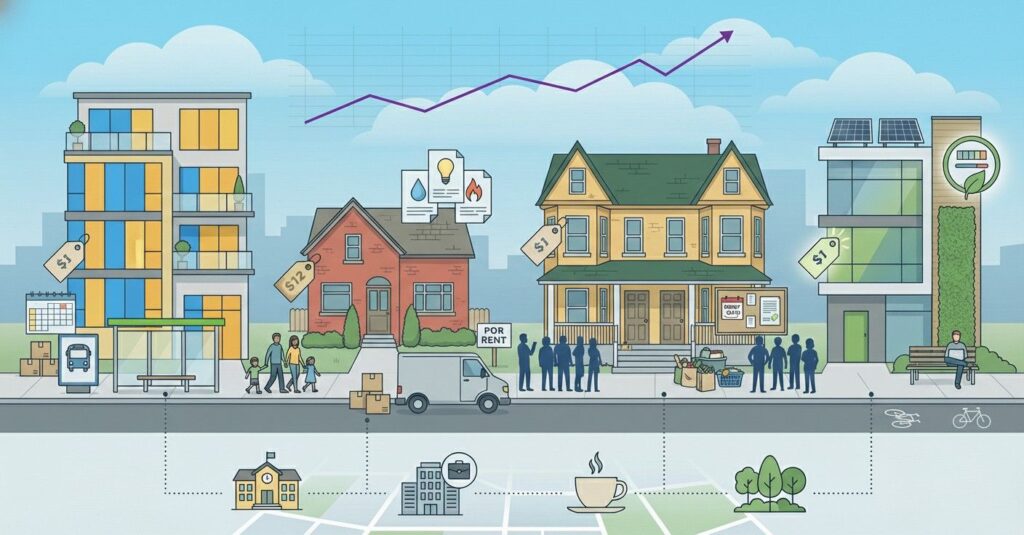
Housing costs tend to dominate everyday thinking, even when people try not to focus on them.
Rent is paid regularly, usually on time, and often without much reflection — until it changes. Then it suddenly becomes the most discussed number in the household.
What makes rent and housing costs stressful isn’t only their size. It’s the uncertainty around why they are what they are, and why they seem to shift unevenly across locations and time.
This explanation looks at rent and housing costs in Australia as a system. Not as a market to beat. Not as a problem to solve. But as a structure that shapes everyday decisions.
Housing Costs Are a System, Not a Single Price
Rent is the most visible part of housing costs, but it’s not the whole story.
Housing costs also include energy use shaped by the building, internet and fixed services, maintenance absorbed into rent, insurance passed through pricing, and the cost of moving or setting up a home.
These layers determine how affordable a property feels over time, not just what’s written on the listing.
That’s why two properties with the same rent can place very different strain on a household.
Why Rent Is Framed Weekly in Australia
Weekly rent is a convention, not a reflection of how people live month to month.
It aligns with historical wage cycles, simplifies comparisons between listings, and allows incremental adjustments without recalculating monthly figures.
The downside is psychological. Weekly numbers feel smaller, even though they accumulate faster across a year than many people expect.
The structure isn’t deceptive — but it does shape perception.
Location Shapes Cost Through Access, Not Distance
Rent isn’t higher simply because a property is closer to a city centre.
What matters is access — to employment, transport, education, healthcare, social infrastructure, and time-saving convenience.
Two areas that look similar on a map can command very different rents if one offers easier daily life.
Housing markets respond to lived convenience, not geography alone.
Property Context Matters More Than Size
Size influences rent, but rarely on its own.
Building age, energy efficiency, layout, noise exposure, parking, storage, and maintenance expectations all affect how a property is priced.
A smaller, efficient dwelling in a high-demand area can feel more expensive on paper but cheaper to live in over time.
Context determines value more than square metres.
Why Rent Changes Arrive All at Once
Rent usually stays fixed during a lease and adjusts at renewal.
This creates stability for a period, followed by a single moment where changes become visible.
Those changes often reflect broader conditions — financing costs, local demand, maintenance pressures — rather than individual circumstances.
The structure makes increases feel sudden, even when they were building quietly in the background.
Supply Numbers Don’t Tell the Whole Story
High housing supply doesn’t automatically reduce rent pressure.
What matters is whether available properties match the type, location, and price people actually need.
Vacant high-end housing does little to relieve pressure on affordable rental segments.
Mismatch sustains cost pressure even when total dwellings increase.
The Quiet Influence of Short-Term Rentals
Short-term accommodation reshapes rental markets without being obvious.
It reduces long-term availability in certain areas, changes landlord risk preferences, and increases pricing sensitivity during peak demand periods.
Even renters who never engage with short-term platforms are affected by their presence.
Why Housing Costs Rise Faster Than Income
Housing prices respond quickly to demand shifts.
Incomes usually respond slowly, often through annual adjustments or job changes.
This timing gap creates sustained pressure, even when employment remains stable.
Utilities as a Second Housing Cost
Energy and service costs amplify housing pressure.
Older buildings, poor insulation, and inefficient appliances increase ongoing expenses regardless of rent level.
A lower-rent property can end up costing more overall once usage is factored in.
Shared Housing and Individual Risk
Sharing reduces per-person costs but introduces dependency and uncertainty.
Solo renting increases financial load but offers control and predictability.
These are structural trade-offs, not right or wrong choices.
Demand Signals and Market Power
Inspections often reveal more than listings.
High turnout indicates replaceability, which limits negotiation regardless of individual reliability.
Decisions are made at a market level, not a personal one.
Stability Versus Flexibility
Longer leases reduce exposure to short-term price shifts.
They also reduce mobility when circumstances change.
Housing costs are not just about money — they’re about how easily life can adapt.
Renting and Ownership Are Different Risk Models
Comparing rent directly with mortgage payments misses key differences.
Ownership concentrates risk and responsibility. Renting transfers much of that risk in exchange for ongoing payments.
Rent is not a loss. It’s a cost for flexibility and reduced exposure.
Why Housing Pressure Feels Heavier Now
Housing takes up a larger share of income than it once did.
At the same time, other essential costs compete more aggressively for the remaining margin.
The issue isn’t just rising prices — it’s shrinking room to absorb them.
Forces That Eventually Slow Growth
Housing markets are cyclical.
Construction activity, migration patterns, policy changes, income limits, and economic slowdowns all exert counter-pressure.
Adjustments happen — but rarely evenly or quickly.
The Emotional Weight of Housing
Housing shapes decisions far beyond budgets.
When housing feels uncertain, people delay plans, avoid risk, and narrow their options.
Stability in housing creates stability elsewhere.
The Real Takeaway
Rent and housing costs are outcomes of overlapping forces, not personal failures or random movements.
Location, access, demand timing, property context, and flexibility all play a role.
Understanding how those forces interact replaces confusion with clarity.
And in a system as emotionally charged as housing, clarity is often the most valuable thing available.