
Fact-checked against Australian Taxation Office on 2026-04-25.
You have probably heard that Australian income tax is one of the most complicated systems going. For most people, it isn’t. The version you actually live with day to day is fairly simple, and the genuinely fiddly bits only kick in for a smaller group of taxpayers. The system has a reputation for being built for accountants. In reality, most Australians can lodge an accurate return on their own once they get the basic mechanics – and the few situations where a tax agent earns their fee are pretty predictable.
The “tax is complicated” assumption
Everyday tax in Australia comes down to four moving parts: how much you earned, how much was withheld during the year, what you can claim as deductions, and which offsets apply. Everything else – capital gains, business income, foreign tax credits, complicated investment structures – sits on top of that base layer, and only the minority who need it ever touch it.
This is the part of the system that gets praised and cursed in equal measure. The ATO has serious data-matching power. Employers report PAYG withholding. Banks report interest. Brokers report dividends. Services Australia reports payments. So by the time you open your return, most of your income is already sitting there, pre-filled. Your job is to check it, add anything that’s missing, and claim your deductions.
For almost any tax question, start at the ATO website. It carries extensive plain-English guidance for individuals and small business, and it’s a good deal more usable than its reputation suggests.
The shape of Australian income tax
Australian income tax is progressive. There’s a tax-free threshold below which you pay no tax. Above it, your income is taxed in brackets, and each bracket’s rate applies only to the slice of income that falls inside it. The current brackets are published on the ATO’s individual income tax rates page, and they get adjusted from time to time by legislation.
Here’s the mistake almost everyone makes. People think earning more and “pushing into a higher bracket” will leave them worse off. It won’t, not in the way they fear. The higher rate only applies to the income above each bracket boundary, never to the whole lot. So a pay rise into a higher bracket always lifts your net income. Yes, the new slice is taxed a bit harder – but you still come out ahead.
Your residency status changes the brackets. Non-residents miss out on the tax-free threshold and pay tax from the very first dollar, at higher rates. We cover the full residency test in our tax residency article.
PAYG withholding – the system most workers actually see
If you’re an employee, this is where you meet the tax system. Pay As You Go (PAYG) withholding works like this: your employer estimates the tax due on each pay packet using the ATO’s published withholding tables, takes that amount out, and sends it to the ATO. Come year end, the total they’ve withheld is usually close to your actual annual liability – close, but rarely exact.
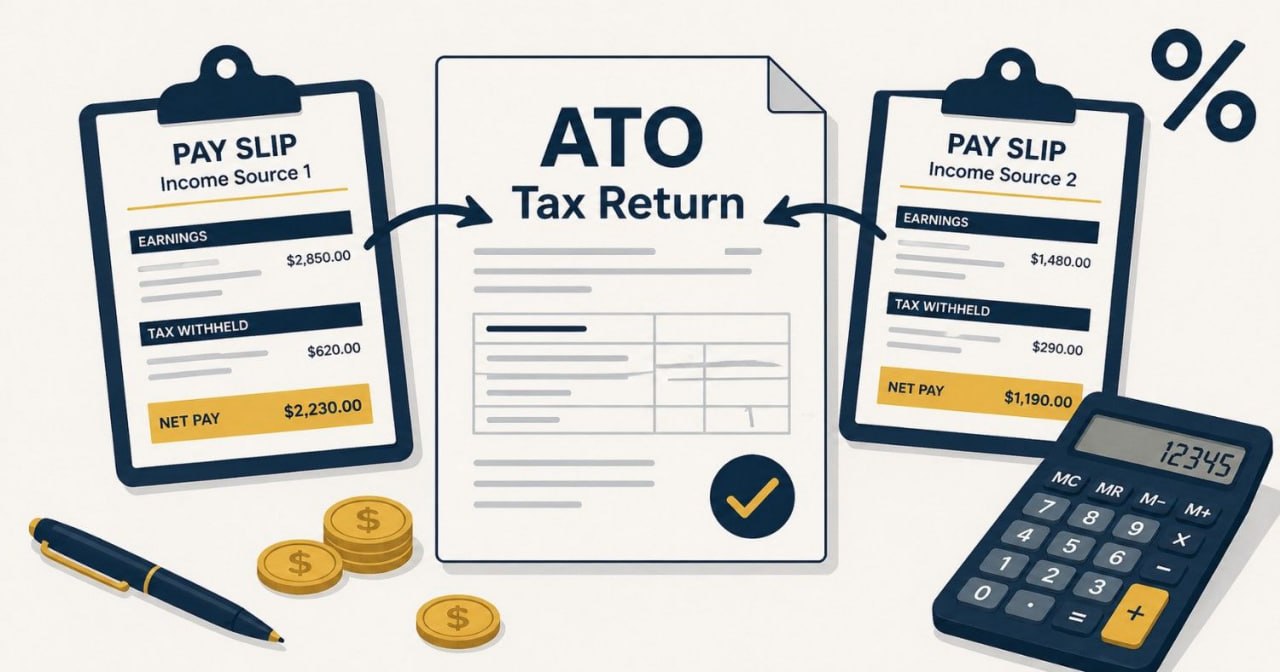
The interesting thing about PAYG is how reliably it over-withholds for some people and under-withholds for others. If you’ve got a second job and didn’t claim the threshold on it, you’ll typically over-withhold and get a refund. If you’ve got deductions or offsets your employer doesn’t know about, same story. And if you’ve got side income that nothing was withheld on, you’ll usually come up short at tax time.
Most of your PAYG settings get locked in at the start of a job through the TFN declaration – we walk through that in our TFN article.
The tax return as reconciliation
At heart, your annual tax return is a reconciliation. It lines up your actual income against your actual tax owed, factors in deductions and offsets, and spits out one of two results: a refund if too much was withheld, or a bill if too little was. Most working Australians land in refund territory, because PAYG tends to slightly over-withhold for typical pay patterns.
We cover the lodgment process in detail in our tax return lodgment article, which walks through who has to lodge, who can opt for non-lodgment advice, and how the whole thing works.
For individual lodgment, the ATO’s your tax return hub is the place to start. It includes myTax, which pre-fills most of your income data automatically.
Deductions and the data-matching reality
A deduction is an amount you subtract from your assessable income before the tax is worked out. The rule is straightforward: you can claim an expense you incurred in earning your assessable income. For most individuals, the claims fall into a handful of common categories:
- Work-related expenses – uniforms, tools, professional memberships, work-from-home costs
- Travel between work locations (not commuting)
- Self-education expenses related to current employment
- Donations to approved deductible-gift-recipient organisations
- Cost of managing tax affairs (e.g., tax agent fees)
This is where the ATO has sharpened up a lot over the past decade. Data-matching. Banks report your interest, employers report your PAYG, brokers report your dividends – and the ATO sets your claimed deductions against all of it. It can flag anything that looks out of step with the benchmarks for your occupation. Claiming big deductions in categories that don’t fit your line of work is a well-known audit trigger.
You need records to back up a deduction. The general rule is to keep them for five years from lodgment. Without records, a claim can be knocked back even when it was perfectly legitimate.
GST and the Medicare Levy
Beyond income tax, there are two layers most people bump into regularly.
GST (Goods and Services Tax)
GST is a flat 10% tax on most goods and services consumed in Australia. Businesses collect it and hand it to the ATO. As a consumer, you mostly just see it baked into the price – businesses here generally include GST in the prices they advertise to you. The detailed rules for businesses live on the ATO’s GST page.
The Medicare Levy
The Medicare Levy is an extra 2% of your taxable income, paid by most Australian tax residents to help fund Medicare. Low-income earners may be exempt or pay a reduced amount under the published thresholds. Don’t confuse it with the Medicare Levy Surcharge, which is a separate charge aimed at higher earners who don’t hold appropriate private hospital cover.
Both the Levy and the Surcharge are collected through the income-tax system, as part of your standard return.
Quick reference: the everyday tax layers, side by side
Most of what you deal with falls into three buckets. Here’s how they line up, using only the figures and rules already covered above.
| Layer | Rate / structure | Who pays | How it’s collected |
|---|---|---|---|
| Income tax | Progressive brackets above the tax-free threshold; each rate applies only to the income within that bracket | Tax residents (non-residents pay from the first dollar at higher rates, with no tax-free threshold) | PAYG withholding through the year, reconciled on the annual return |
| GST | Flat 10% on most goods and services | Consumers, via the price (collected by businesses) | Remitted to the ATO by businesses |
| Medicare Levy | 2% of taxable income | Most tax residents; low-income earners may be exempt or pay a reduced amount | Through the income-tax system, as part of the standard return |
Marginal vs average rate – an illustrative walk-through
Illustrative only. The numbers below are made up to show how the brackets behave – they are not real ATO rates or thresholds. Always use the live figures on the individual income tax rates page.
Say the first $10,000 is tax-free, the next slice is taxed at 20%, and income above $40,000 is taxed at 30%. Earn $50,000 and only the top $10,000 is taxed at 30% – the slice from $10,000 to $40,000 is still taxed at 20%, and the first $10,000 is untaxed. A pay rise that lifts you from $40,000 to $50,000 doesn’t claw back the tax on your earlier income; the higher 30% rate only touches the new $10,000. That’s why your marginal rate (the rate on your next dollar) is always higher than your average rate (total tax divided by total income) – and why “moving into a higher bracket” never leaves you worse off.
Frequently asked questions
How does the Australian tax-free threshold work?
The tax-free threshold is the amount of income an Australian tax resident can earn each year without paying income tax. Above the threshold, tax applies to each subsequent dollar at progressively higher rates. Only one job at a time can claim the threshold, and the rules apply to most working tax residents but not non-residents.
What is the Medicare Levy and who pays it?
The Medicare Levy is an additional tax that funds part of Medicare’s costs. Most Australian tax residents pay it as a percentage of taxable income. Low-income earners can be exempt or pay a reduced amount under low-income thresholds. A higher-income Medicare Levy Surcharge applies separately for those without appropriate private hospital cover.
Are tax deductions automatic in Australia?
No. Tax deductions are claimed by the taxpayer when lodging a return. Common deductible expenses include work-related costs, donations to approved charities, and certain investment-related expenses. Receipts and records are required to substantiate claims, and the ATO has data-matching capability that flags unusual or unsupported deductions.
What most working Australians actually need to understand
If you take one thing away, make it the difference between your marginal and average tax rates. Your marginal rate is what you pay on the next dollar you earn. Your average rate is your total tax divided by your total income. People quote the marginal rate as if it applied to everything, which is exactly what fuels the panic about “moving into a higher bracket” – panic the actual numbers don’t support. Your average rate is almost always lower than your marginal rate, and it’s the one that really drives your take-home pay.
The second thing is records. Keeping five years of receipts, log books, mileage records and invoices is dull, but it’s what stands between a deduction that survives ATO data-matching and one that gets reversed at audit. Most genuinely deductible expenses are easy to back up if you’ve kept the paperwork. Most denied deductions fell over at the records stage, not because the claim was bogus.
And if your situation runs past standard PAYG and a few deductions – an investment property, business income, foreign income, capital gains, complex super contributions – a registered tax agent is usually worth the cost. The ATO publishes the TPB register, and in those situations the value a professional adds is real.