
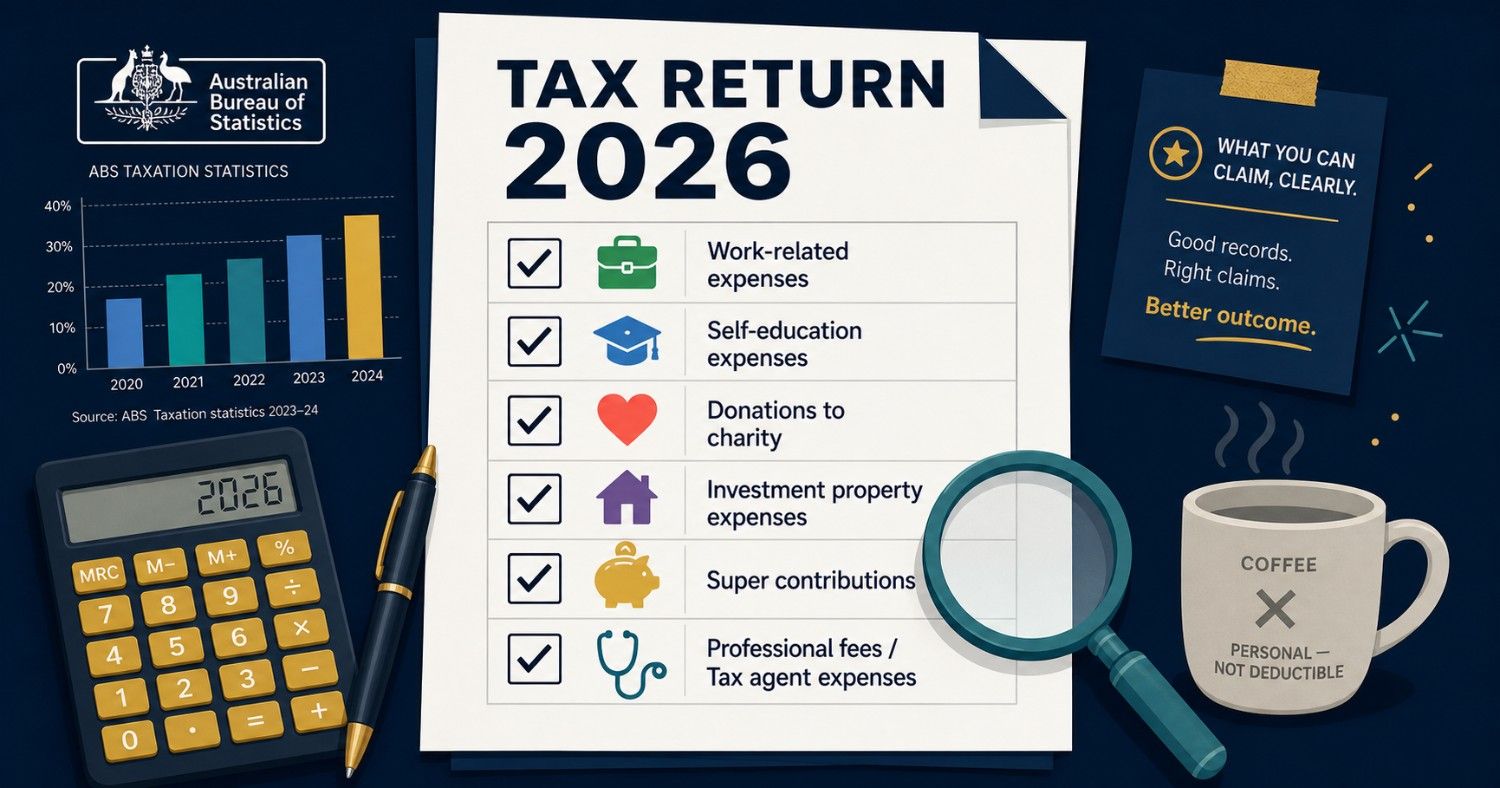
Fact-checked against ATO – Deductions you can claim on 2026-05-02.
Most working Australians underclaim on their tax return. Not by being reckless, and not by playing it safe on purpose – they simply don’t know what’s actually claimable. Going by the average deductions the ATO publishes per occupation, the typical taxpayer leaves somewhere between a few hundred and a few thousand dollars on the table every year. A smaller group does the opposite, overclaims, and ends up with the ATO knocking. This guide sorts out what’s genuinely deductible in 2026, what isn’t, and exactly what records you need so the claim holds up if you’re ever asked to prove it.
The three rules every deduction has to pass
Before you get into any specific category, there are three tests the ATO runs on every single deduction. Get one of them wrong and the claim falls over – and that’s exactly where most denied claims come unstuck, not because the category itself was off-limits.
- The expense must be incurred in earning your assessable income. There has to be a clear connection between the cost and the income you earned. A nurse buying nursing scrubs passes. A nurse buying everyday casual clothes for the bus to work doesn’t.
- You must have spent the money yourself, and not been reimbursed. If your employer reimbursed you for the cost, you can’t claim it. The ATO’s data-matching can detect employer-reported reimbursements.
- You must have a record to prove it. The general standard is written evidence (receipt, invoice, bank statement, or similar). Records must be kept for five years from the lodgment date.
People treat these three as friendly suggestions. They aren’t. They’re hard requirements, which is why the ATO’s deductions you can claim hub puts them at the top of every category page.
If you want the wider picture of how the pieces fit together, the Australian tax system overview and the tax return lodgment article on this site cover the surrounding framework.
The cost of managing tax affairs
This is the deduction more people should claim and simply don’t. The ATO’s cost of managing tax affairs page lays out what’s covered.
Claimable in this category:
- Fees paid to a registered tax agent for preparing or lodging your return
- Subscription costs for tax software (e.g., commercial tax preparation tools)
- Travel costs to and from a tax agent’s office
- Costs of objecting to or appealing an ATO decision
- Cost of attending tax-related courses or seminars
There’s a neat quirk here. Because the agent’s own fee is deductible, the government is effectively chipping in for part of your professional tax help. Pay an agent $200-400 and getting that back as a deduction trims the net cost in a way that actually matters – and a good agent tends to surface other deductions you’d have walked straight past.
Donations to charity
Donations only count if they go to organisations registered as Deductible Gift Recipients (DGRs). The ATO’s gifts and donations page spells out the detail.
Key rules:
- The recipient must be a DGR – most well-known charities are, but it’s worth checking the official ATO DGR register
- The donation must be a genuine gift – no personal benefit received in return
- For donations above $2, you need a receipt
- Crowdfunding contributions, fundraising raffle tickets, and “fundraising dinner” payments where you receive food/entertainment are generally not deductible
Workplace giving – those small, regular donations through payroll – slips through unclaimed all the time. It’s a clean deductible expense documented in your PAYG records, yet plenty of employees forget to mention it at lodgment, and it won’t always pre-fill on its own.
Investment-related deductions
Own shares, bonds, managed funds, or a rental property? A solid chunk of your investment-related expenses can be deducted against the income those investments throw off.
For shares and managed investments:
- Investment management or advice fees
- Margin loan interest where the loan is for investment purposes
- Cost of investment-related publications and tools
For rental properties (a big one for Australian investors):
- Loan interest on the investment loan
- Council rates, water charges, body corporate fees
- Repairs (immediate) versus capital improvements (depreciated)
- Property management fees
- Depreciation of fittings and capital works
- Travel for property inspections (with significant restrictions since 2017)
The ATO watches rental deductions like a hawk. The line between a “repair” (deductible right away) and an “improvement” (depreciated over time) gets pulled apart again and again, so for property investors a registered tax agent usually earns their fee.
Personal super contributions
Personal contributions to super made from after-tax income can be deductible against your taxable income, with several caveats.
To claim:
- The contribution must be made within the financial year and before any caps are exceeded
- You must lodge a “Notice of intent to claim a deduction” with your super fund and receive an acknowledgment
- The fund must include the contribution in its assessable income (so 15% contributions tax applies inside the fund)
- You must be eligible to contribute personally (most working-age people are, but some restrictions apply for very high contributions or early-access scenarios)
Here’s the trap most people fall into: skip the Notice of intent step and the contribution gets treated as a non-concessional (after-tax) contribution, which means no deduction. The notice has to be lodged before the earlier of two dates – the end of the next financial year, or the day you lodge your return for that year.
For the broader rules around super, our superannuation eligibility article and early-access rules article cover the wider context.
What you can’t claim – common mistakes
Knowing what’s off the table matters just as much as knowing what’s on it. These are the claims most likely to get knocked back at audit:
- Daily commute – between home and your regular workplace, not deductible (with narrow exceptions for itinerant workers and those carrying genuinely bulky equipment)
- Conventional clothing – business suits, smart-casual office wear, formal shoes – not deductible even when employer requires “professional attire”
- Gym memberships – generally not deductible, even for jobs requiring fitness, unless very narrow conditions are met (e.g., professional sportspeople)
- Childcare expenses – not a tax deduction (separate Child Care Subsidy applies, covered in our aged care and childcare costs article)
- Self-education for getting a new job in a different field – only current-job-related study is deductible
- Personal living expenses – food, drink, personal grooming, even if consumed at work
- Speeding fines and parking fines – never deductible, even if incurred while on work duties
If you’re juggling more than one job, there’s extra fine print around deductions and withholding – the multiple jobs and tax article walks through it.
Deductible vs not deductible – the categories at a glance
Most of the confusion at tax time comes down to one question: does this expense actually clear the three rules above, or does it just feel like it should? Here’s how the main categories from this guide line up, with the catch that trips people up most.
| Category | Deductible? | The catch |
|---|---|---|
| Travel between two workplaces same day | Yes | Home-to-regular-workplace commute is not |
| Occupation-specific, protective, registered uniforms | Yes | Conventional clothing isn’t, even if required |
| Tools and equipment | Yes | Under $300 in full; above $300 depreciate over effective life |
| Self-education | Sometimes | Only if it relates to your current job, not a new field |
| Cost of managing tax affairs | Yes | Includes the tax agent fee itself |
| Charity donations | Sometimes | DGR only, genuine gift, receipt needed above $2 |
| Personal super contributions | Sometimes | No Notice of intent lodged = no deduction |
| Gym, commute, childcare, grooming, fines | No | Off the table regardless of how work-adjacent they feel |
A worked example – Illustrative only
To show how the small stuff stacks up, here’s a rough run using only the numbers already in this guide. Say you pay a tax agent $400 (the top of the $200-400 range), claim $300 of tools in full, and add a handful of those quietly-forgotten deductions. The closing section puts six $200-400 deductions at a deduction in the low thousands, and notes that at a 32.5% marginal tax rate this can mean $400-700+ of refund that otherwise just evaporates. The point isn’t the exact figure for your situation – it’s that each line on its own looks too small to bother with, and together they don’t.
What matters most, in order
- Pass the three rules first. Connection to income, money spent by you, and a record to prove it. Everything else is irrelevant if a claim fails one of these.
- Get your records sorted as you go. Written evidence kept for five years from the lodgment date is what keeps a claim standing if the ATO asks.
- Claim the cost of managing tax affairs. The most-missed deduction, and the agent fee that pays for itself is part of it.
- Lodge the Notice of intent before you claim personal super. Miss this step and the deduction is gone.
- Tally the small recurring ones. Union fees, donations, income protection, subscriptions – the ones that hide in direct debits.
Frequently asked questions
What’s the most commonly missed tax deduction in Australia?
The cost of managing tax affairs is one of the most commonly missed deductions. Tax agent fees, tax-software subscriptions, and travel costs to see a tax agent are all deductible. Many taxpayers also miss income protection insurance premiums (paid outside super) and small work-related subscriptions. Records are required, and the deduction is claimed in the year the expense was incurred.
Do I need receipts to claim tax deductions in Australia?
For most claims, yes. The ATO requires written evidence for any single claim above $300 in total work-related expenses (and even below that for specific categories). Donations need receipts for any claim above $2. Records must be kept for five years from the lodgment date. Some categories (uniforms below set thresholds, small consumables) have simpler record requirements but still need basic substantiation.
Can I claim my commute to work as a tax deduction?
No. Travel between home and your regular place of work is private travel and isn’t deductible, even if you make work calls or carry work tools. Travel between two separate workplaces, travel for work duties (visiting clients, attending offsite training), and travel for itinerant work can be claimable. The ATO’s distinction is whether the travel is part of your job or just getting to it.
The single most-missed deduction in Australia
Across every pattern here, the biggest miss in Australia isn’t one category at all. It’s the belief that small expenses aren’t worth the bother. Union fees get left off because they’re “only $400 a year”. Donations get skipped because the receipts never made it into a folder. Income protection premiums tick over on direct debit and slip the mind. Professional journal subscriptions get billed quietly to a card and never counted at lodgment.
It adds up fast. Half a dozen $200-400 deductions across categories that genuinely qualify can produce a deduction in the low thousands. At a 32.5% marginal tax rate, that’s $400-700+ of refund left sitting unclaimed every year.
So the move – especially with tax season looming – is to set up a dead-simple records routine now. One folder, digital or paper, where receipts, invoices, and confirmation emails land all year, and a quick reconciliation when you lodge. The ATO’s deductions hub is still the authoritative starting point for any specific category, and the myDeductions tool inside the ATO app makes the record-keeping far less painful than it used to be.
If your situation runs to multiple income sources, working from home, or an investment property, the deduction picture gets bigger and more worth getting right. A registered tax agent generally earns their keep there – and the fee is itself deductible, which is exactly the kind of system quirk that makes plain-English explainers like this one worth writing.
20 deductions Australians most often forget
The common ones – work from home, vehicle, donations – get all the airtime. The deductions below are the ones that quietly add up and that most people don’t think to claim. Each is anchored to the ATO category that authorises it.
- Union and professional association fees – fully deductible. Includes nursing, teaching, engineering, legal, medical professional bodies.
- Tax agent fees – last year’s tax-prep fee is deductible this year. Most people deduct it without realising it qualifies.
- Income protection insurance premiums – deductible (premiums for policies that pay out a wage replacement). Life insurance premiums inside super, however, are not.
- Self-education costs directly tied to current role – courses, books, conference fees, travel to study. Must connect to current employment, not aspirational career changes.
- Sun protection for outdoor workers – sunscreen, sunglasses, hats. Specifically permitted under work-related expenses for those who work outdoors.
- Tools and equipment under $300 – fully deductible in the year of purchase. Above $300, depreciate.
- Protective clothing and laundry – high-vis, steel-toed boots, lab coats, scrubs. Includes laundry costs (deductible flat rate of $1/load if work-only, $0.50 if mixed).
- Home office equipment depreciation – a $1,200 monitor used 70% for work depreciates at the work-use percentage. Stacks on top of fixed-rate WFH claims.
- Phone and internet (work-portion only) – only valid under actual-cost method, not on top of fixed-rate WFH. Requires a 4-week diary to substantiate.
- Briefcase, backpack, or bag for work tools – deductible if used to carry work documents or tools. Must be primarily for work, not personal.
- Conferences and seminars in your field – registration fees, travel, accommodation. Personal extension days are not.
- Professional indemnity and public liability insurance – for sole traders, contractors, allied health.
- First-aid courses required for your role – fully deductible if your employer requires the certification.
- Subscriptions to industry publications – journals, trade magazines, industry research databases.
- Mileage between work locations on the same day – driving between two workplaces (not from home) is deductible. Home-to-first-workplace is not.
- Donations to DGRs (Deductible Gift Recipients) – must be $2 or more, and the receiving entity must be on the ATO DGR register.
- Costs of managing your tax affairs (other than the agent fee) – software like spreadsheet apps used for tax records, photocopying for tax records, postage of tax documents.
- Working dog expenses (where applicable) – for security guards with working dogs, food and vet costs are partially deductible.
- Compulsory uniform with employer logo – if it’s branded employer-uniform (not just plain clothing in your employer’s colours).
- Bank fees on accounts used to receive investment income – for income-producing accounts, account-keeping fees are deductible.
What’s not deductible (despite popular belief): commuting to/from work, regular work clothing (suits, business attire), grooming, gym memberships (with very narrow exceptions for tactical-response professionals), childcare, and food consumed at work.