
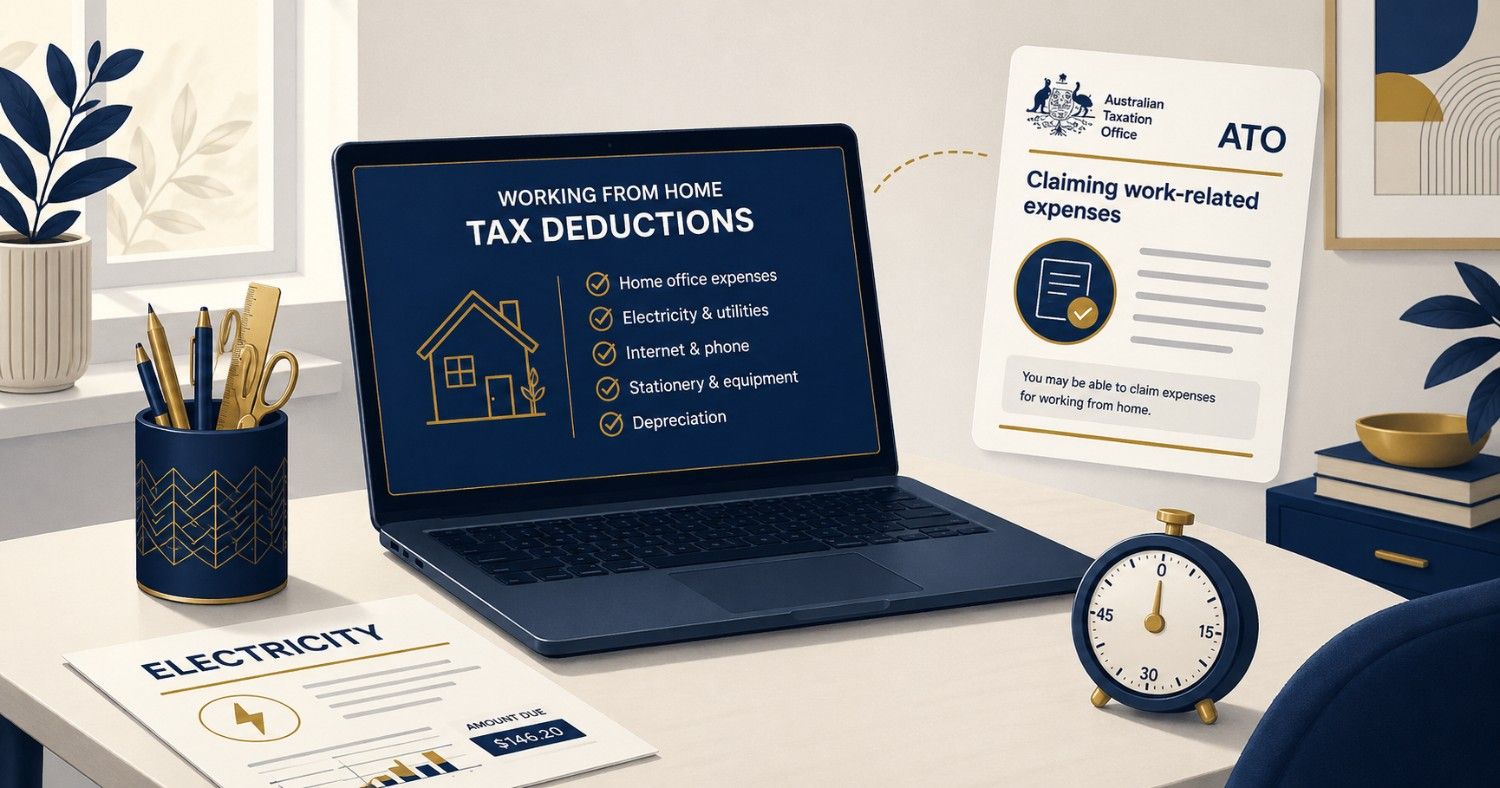
Fact-checked against ATO — Working from home expenses on 2026-04-28.
There’s a popular belief that working from home hands you a generous slice of your living costs as tax deductions. The ATO doesn’t see it that way. The rules around working-from-home (WFH) deductions are tighter and more specific than most people realise, and the gap between what people claim and what they’re actually entitled to is exactly where ATO audit attention has been landing in recent years. The legitimate deductions are real money. The catch is they need a specific method, specific records, and an honest split between work use and personal use.
Why “I work from home so I can claim everything” is wrong
The most common WFH-deduction misconception is also the most expensive: the idea that working from home unlocks a flat right to claim a chunk of your home costs without much effort. The reality is narrower. The ATO treats WFH expenses for employees as a type of work-related expense, governed by the same general rules as any deduction. There has to be a clear connection between the cost and earning your income, and you have to work out the work-related portion in a sensible way.
That alone rules out a lot of the casual claims people make. Coffee made at home? Not deductible. It’s a personal cost no matter where you work. Food during work hours? Same answer. Rent? Generally no, not for ordinary employees who happen to work at home some days. The full ATO position is on the working from home expenses page, and it’s worth reading directly rather than going off what someone said at a barbecue.
The good news is that what you can deduct is real. The next sections walk through what’s actually claimable, the two methods you can use, and the records that hold up if the ATO asks.
What the ATO actually lets you deduct
In ATO language, working-from-home expenses fall into two buckets: running expenses and occupancy expenses. The split matters. Most employees can only claim running expenses. Occupancy expenses are usually off the table unless your home meets some specific criteria.
Running expenses (claimable for most WFH workers)
- Electricity and gas for the work-use portion of your home
- Internet – the work-related share of the bill
- Phone – work-related calls and data
- Decline in value (depreciation) of work-related equipment over a defined limit (computer, monitor, chair)
- Repairs and maintenance to work-related equipment
- Stationery and consumables genuinely used for work
Occupancy expenses (mostly NOT claimable for employees)
- Rent
- Mortgage interest
- Council rates
- House insurance premiums
- Land tax
Occupancy expenses are generally only claimable when part of your home is used as a place of business, not just somewhere you happen to work. The bar for a “place of business” is high – think a sole trader running a clinic from home. And even when you clear that bar, claiming occupancy expenses can trigger capital gains tax on that portion of the home when you sell it. For most employees, claiming occupancy expenses is a worse deal than leaving them alone.
The two methods – fixed rate vs actual cost
The ATO gives you two ways to work out WFH deductions for running expenses. Picking the right one matters more than people think, because the two can produce very different deduction amounts.
Method 1: The fixed-rate method (simpler)
With the fixed-rate method, you claim a set amount for every hour you work from home. The ATO publishes the rate and changes it from time to time. The current rate, and what it covers, sits on the fixed-rate method page.
The fixed rate bundles a list of running costs into that hourly figure – typically electricity, gas, internet, phone, and stationery. The upside is obvious: it’s quick to calculate, and you don’t need a detailed receipt for every item already covered. The downside is that one rate has to fit everyone, so it can understate your real costs if you run a power-hungry home setup.
Method 2: The actual-cost method (more work, sometimes a bigger deduction)
The actual-cost method works out each expense on its own, based on its real work-related share. The rules sit on the actual-cost method page.
For each cost, you figure out the work-related percentage and claim that share. Electricity is usually based on the wattage of the devices you use, your work hours, and a fair split between work and household use. Internet is often worked out as the percentage of total household use that’s work-related, backed by a representative four-week diary.
The actual-cost method asks for more records, but it can land a much bigger deduction for households with high running costs and serious WFH hours. The trade-off is the time it takes. Plenty of taxpayers find the fixed rate nets them more once they account for the hours saved.
One rule catches people out: you can use only one method per income year, and you have to apply it consistently. You can’t switch between the two methods mid-year.
Records the ATO expects you to keep
Records are where most denied claims fall apart. The ATO has specific record-keeping expectations for both methods, and they’re stricter than most people prepare for. The general framework is on the records you need to keep page.
Records under the fixed-rate method
- An ongoing record of hours actually worked from home – a timesheet, diary, work calendar, or rostered-hours log
- At least one bill (or other document) for each running cost the rate covers – this proves the cost was incurred
- Records of any expenses you claim separately on top of the rate (for example, depreciation of work equipment)
Records under the actual-cost method
- A detailed hours record
- Receipts and bills for each expense you’re claiming
- A representative four-week diary showing how each expense splits between work and personal use
- Calculations showing how you arrived at the work-related percentage
You have to keep all records for five years from the date you lodge the return. The ATO’s data-matching – touched on in our tax system overview – means it can cross-check your claims against employer reports, energy provider data, and the like. Claims that don’t fit the patterns the ATO expects tend to trigger a request to substantiate them.
The mistakes that trigger ATO attention
A handful of errors show up year after year in the patterns the ATO flags. Steer clear of these and your return stays clean, even under data-matching scrutiny.
1. Claiming the whole bill, not the work portion
This is the big one. Claiming a full electricity bill or internet bill as a WFH expense, with no split between work and personal use, is the textbook over-claim. The ATO always expects the work-related share, never the whole amount.
2. No records of hours worked
An “estimate” with nothing behind it is the second-most-common reason claims get knocked back at audit. The ATO wants an ongoing log, not a number you guess at the end of the year. You can reconstruct hours after the fact in narrow circumstances, but it’s rarely accepted as your primary record.
3. Claiming personal items as work expenses
Coffee, food, household furniture you use for both work and life, ergonomic mats in shared spaces, and similar grey-area items get claimed often and denied often. The “personal in nature” exclusion is broad, and it catches a lot.
4. Double-dipping with employer reimbursements
If your employer reimburses a WFH expense, you can’t also claim a deduction for it. People forget about reimbursements – especially the small ones for internet or phone – and accidentally double-claim. The ATO matches against employer data, so this one surfaces.
5. Mixing methods
One method per year. Some taxpayers try to run the fixed rate for a few months and actual cost for the rest. That isn’t allowed, and it leaves you with messy records that don’t properly substantiate either method.
If you’ve got more than one income source, your WFH split also has to line up with how that income is reported. The multiple-jobs and tax rules bring their own wrinkles, and they interact with WFH claims.
When claiming WFH expenses isn’t worth the effort
Here’s a question that often gets skipped: is the deduction actually worth the work? Sometimes it isn’t, and being honest about that saves you time without costing you a cent.
The situations where WFH deductions tend not to pay off:
- You only work from home occasionally – a handful of days a year. The deduction is small, but the record-keeping effort is the same.
- Your employer fully reimburses your running costs. Reimbursed costs aren’t claimable, so there’s nothing left to deduct.
- You’re in a shared-living setup where apportioning costs is genuinely hard and the final figure is tiny.
- You’ve kept no records and you’d be reconstructing from memory at lodgment. Better to claim nothing than to claim a figure that won’t hold up.
For everyone else – regular WFH workers with at least basic records – the deduction is worth claiming. Depending on your hours and home setup, it often runs from the hundreds into the low thousands of dollars a year.
For more on how lodgment fits into the bigger picture, the who needs to lodge a tax return article covers the broader rules.
Worked example: which method wins at different WFH patterns?
Illustrative only. The fixed-rate method is easier to run, but it isn’t always the bigger deduction. Here’s how the two methods compare across realistic WFH patterns for FY 2025-26 (fixed rate $0.70/hr; the actual-cost figures are rough estimates that assume average Australian household running costs and leave out one-off equipment depreciation). These numbers illustrate the trade-off, not your exact return.
| WFH pattern | Hours/year | Fixed rate ($0.70/hr) | Actual cost (estimated) | Usually better |
|---|---|---|---|---|
| 1 day/week, kitchen table | 365 | $256 | ~$120-180 | Fixed rate |
| 2 days/week, kitchen table | 730 | $511 | ~$240-360 | Fixed rate |
| 3 days/week, dedicated desk | 1,095 | $767 | ~$500-800 | Roughly even |
| 5 days/week, no dedicated room | 1,824 | $1,277 | ~$800-1,200 | Fixed rate |
| 5 days/week, dedicated room + equipment depreciation | 1,824 | $1,277 | $1,500-3,000+ | Actual cost |
The pattern: the fixed rate wins for casual or hybrid arrangements because $0.70/hr already folds in electricity, internet, phone, stationery, and computer consumables – categories that are hard to reach on actual-cost sums alone. The actual-cost method only pulls ahead when you can legitimately add depreciation on a dedicated office setup (computer, monitor, chair, desk) and you’ve got the records to back it.
Hidden gotcha most guides miss: if you go fixed rate, you can’t also claim a separate deduction for any item it bundles. A $150 internet claim on top of $0.70/hr is not allowed, and the ATO will adjust your return down. The fixed rate is all-inclusive for those categories. The only things you can stack on top are equipment depreciation, occupancy costs (rare for employees), and consumables outside the bundle.
What matters most, in order
If you do nothing else, do these – and do them in this order. The first item carries the most weight, because it’s the one that decides whether your claim survives at all.
- Keep a running log of WFH hours. No log, no solid claim. A calendar entry for each WFH day is enough.
- Pick one method for the whole year and stick to it. Fixed rate or actual cost – not both.
- Keep at least one bill per running-cost category. Under the fixed rate this proves the cost was incurred; under actual cost it feeds the calculation.
- Claim only the work-related share. Apportion every cost; never claim the whole bill.
- Subtract anything your employer reimbursed. Reimbursed costs aren’t claimable, and the ATO matches employer data.
- Hold every record for five years. That’s the window the ATO can ask you to substantiate the claim.
Frequently asked questions
Can I claim my rent if I work from home in Australia?
Generally no, not unless your home has a dedicated work area used as a place of business — and even then, claiming rent or mortgage interest can have capital gains tax consequences when you sell. For most employees who simply work from home, rent and mortgage interest aren’t deductible. The ATO treats WFH for employees as expense-claiming, not occupancy-claiming.
What records do I need to keep for working-from-home deductions?
For the fixed-rate method, you need a record of hours worked from home (timesheet, diary, or calendar) and at least one piece of evidence for each running cost (electricity bill, internet bill, etc.). For the actual-cost method, you need detailed records: hours, receipts, and a representative four-week diary showing work-versus-personal split. Records must be kept for five years.
Can I claim my home internet if I use it for work?
Yes, but only the work-related portion. The ATO requires you to apportion between work and personal use. Under the fixed-rate method, internet is one of the running costs the rate already covers, so you can’t double-dip. Under the actual-cost method, you’d calculate the work-use percentage and claim that share of your bill.
The single thing most WFH workers get wrong
The single most expensive mistake WFH workers make isn’t over-claiming or under-claiming – it’s not keeping records as the year goes on. The deduction itself is straightforward when the records exist. Without them, it either gets watered down (because reconstructing from memory makes you conservative) or denied at audit (because the ATO’s standard is documents, not estimates).
The fix is genuinely simple. Pick a method at the start of the year. Set up a basic hours-tracking habit – a calendar entry for each WFH day does the job. Keep one bill from each running-cost category. Update both as you go. That’s the whole routine. Come lodgment, the claim takes minutes instead of hours, and it substantiates cleanly if the ATO ever asks.
So if you’re a regular WFH worker, the practical move is to read the ATO’s current rules at the start of each financial year – they shift from time to time, especially the fixed rate – and to put that small records routine in place before the year starts, not after it ends. The ATO working-from-home page stays the authoritative source for what’s currently allowed.