
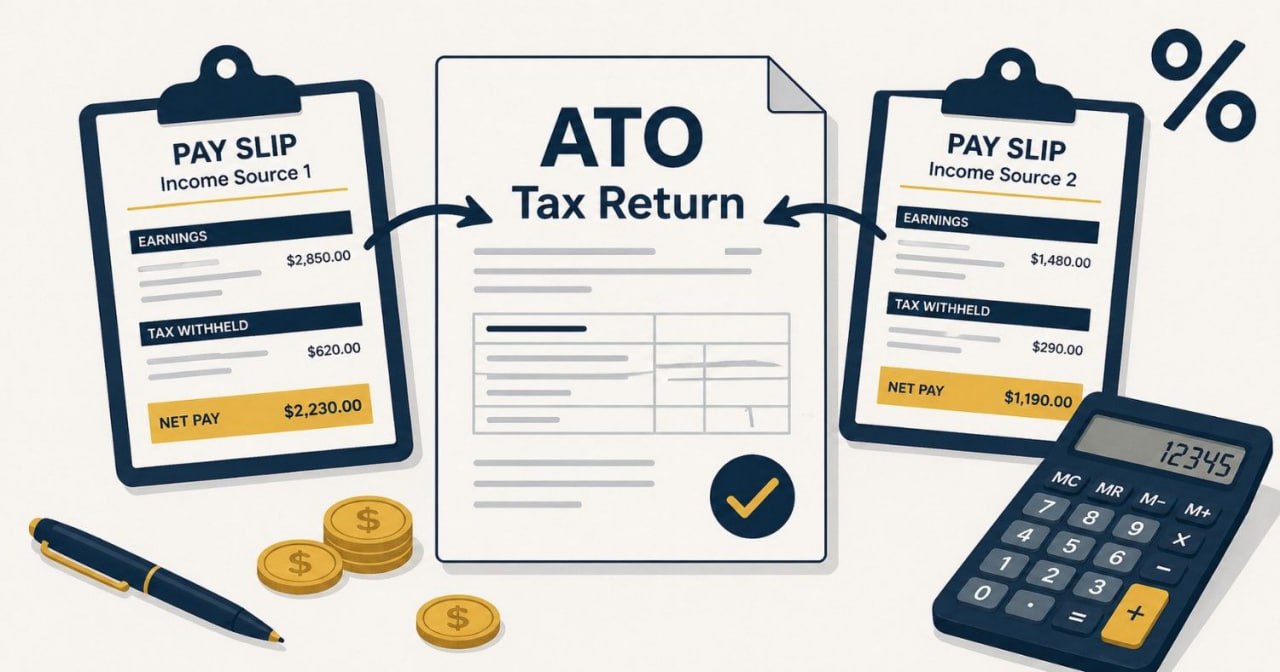
Fact-checked against ATO — Multiple jobs or multiple payments on 2026-04-25.
Picking up a second job is the most common reason working Australians get a nasty shock at tax time. You’d assume each employer takes out the right amount of tax, so it all evens out when you lodge. It usually doesn’t. And the gap isn’t anyone making a mistake – it’s baked into how the system is built. Here’s what nobody warns second-job workers about: each employer’s PAYG sum is correct in isolation, but stack two of them together and you end up under-withheld until lodgment squares it up. So instead of the refund you were counting on, you get a bill. And it’s rarely small.
The single rule that catches workers out
The rule sits in plain sight on the ATO’s multiple jobs or payments page: you can only claim the tax-free threshold on one job at a time. The ATO says to claim it on your highest-paying job. Your TFN declaration asks the question directly – “Do you want to claim the tax-free threshold from this payer?” – and the answer is Yes for the job that pays you most, and No for every other one.
Why does it matter so much? Claim the threshold on both jobs and each employer treats their pay as if it’s your only income. Both hand you the tax-free amount on the slice they’re paying. So the total tax coming out is well short of what you actually owe once your whole income is added up. That gap is your year-end bill.
Fixing it is simple – claim the threshold once and only once. The trap is that plenty of workers don’t know the rule, or they tick it on the wrong job, and the under-withholding quietly piles up for months before anyone notices.
The tax-free threshold and why it can only sit on one job
The tax-free threshold is a single allowance that applies to your total income for the year, not to each job on its own. You’ll find the current amount on the ATO’s tax-free threshold page.
The ATO applies the whole threshold once, across everything you earn. But each employer is off in its own corner working out PAYG only on the pay it gives you. So when you claim the threshold on more than one job, you’re effectively claiming the same allowance twice in the withholding – and that can never hold up when your return is reconciled.
Here’s how it actually plays out:
- Job 1 (claim threshold): pays first portion of income tax-free, then taxes the next portion at lower rates
- Job 2 (no threshold): should withhold tax from the first dollar at the standard rate
- Year-end: total income gets taxed once with one threshold, and the combined withholding either matches, exceeds, or falls short of the actual liability
When both jobs claim the threshold, Job 2 takes out far less than it should. That shortfall builds through the year, and it turns into the bill you cop at lodgment.
How combined income pushes brackets up
Even when you’ve done the right thing and claimed the threshold on just your highest-paying job, two jobs can still leave you short at year-end – and for a separate reason: how the brackets interact. Each employer works out withholding as though their pay is all you earn, so each one taxes you within the brackets that would apply if that single job were your whole income.
Add the two together and your total income often lands in a higher bracket than either employer is withholding for. The withholding tables can’t see your second job, so they can’t allow for it. At lodgment the ATO applies the real progressive rates to your combined income, and the difference between what should have come out and what actually did becomes the bill.
You’ll see this most often when:
- Both jobs pay in a similar bracket range, but combined push into a higher bracket
- One job is occasional or seasonal and the other is steady
- Both jobs are part-time, but together exceed the full-time threshold for higher brackets
Why year-end produces a bill instead of a refund
Your tax return is a reconciliation, nothing more. Add up your income. Work out the tax owing using the progressive rates. Subtract everything that was withheld through the year. Withheld more than you owe? Refund. Less? Bill.
People with more than one job tend to land on the bill side for a handful of reasons:
- The threshold being incorrectly claimed twice (worst case)
- Combined income crossing into higher brackets than either employer was withholding for
- The Medicare Levy being correctly withheld on each job but not enough on the combined income
- The HELP repayment trigger (if applicable) being missed because each employer didn’t see the combined income
The first three get sorted out automatically when you lodge. The HELP one is worth a closer look – our HECS-HELP article walks through how the repayment process is set up, and it’s exposed to exactly the same multiple-jobs gap.
Fixing the withholding through the year
If you can see a shortfall coming – or you just want to head one off – you can lift your withholding partway through the year with any of your employers. The tool for the job is the Withholding Declaration:
- Complete a Withholding Declaration with the relevant employer
- Specify additional tax to be withheld each pay period
- The employer adds that amount to the standard PAYG withholding
- The extra withholding shows up at lodgment as additional credit, reducing the bill (or producing a refund)
The ATO has tax withheld calculators to help you land on the right figure. You’ll find the TFN declaration and Withholding Declaration forms on the ATO’s forms hub.
Prefer to leave your pay alone and just save for the bill instead? Estimate the gap with the ATO’s tax estimator and tip that amount into a separate account every payday. Either way works, and both spare you the bill-shock.
Beyond two PAYG jobs – gig, contract, and side income
This isn’t just a two-PAYG-employees problem. The same thing happens to:
- Workers with one PAYG job and side income from gig work, freelancing, or contracting (where no PAYG is withheld at all)
- Workers with multiple casual jobs across different employers
- Workers with one PAYG job and rental property income
- Workers receiving taxable Centrelink payments alongside employment
The ATO’s working as an employee section covers the rules for all of these. The principle doesn’t change: the more income you have that nobody is withholding against in a combined-aware way, the more likely you are to come up short at year-end.
If you’ve got a decent chunk of non-PAYG income, the ATO’s PAYG instalments system – paying your expected tax in quarterly chunks – is often the tidiest way to spread the load across the year. For most people juggling a couple of straightforward jobs, a Withholding Declaration on one of them does the trick.
The two reasons quick reference
The two causes of bill-shock look similar from the outside but they’re different problems with different fixes. Here’s how they line up:
| Cause | What goes wrong | Whose “fault” | The fix |
|---|---|---|---|
| Threshold claimed twice | Both employers apply the tax-free amount, so Job 2 withholds far too little | A setup error you can correct | File a new TFN declaration so only the highest-paying job claims it |
| Bracket interaction | Combined income lands in a higher bracket than either employer withholds for | Structural – nobody is at fault | Lodge a Withholding Declaration to take out extra, or save for the bill |
Notice that even doing everything right still leaves the second row in play. That’s why the ATO reconciles at lodgment – it’s the only point where your full income is seen in one place.
In order: what to do if you’ve just picked up a second job
If you only act on a few things, work down this list in order. The top item matters most.
- Check both TFN declarations – the tax-free threshold should sit on your highest-paying job and nowhere else.
- If it’s on the wrong job, file a new TFN declaration with each employer to correct it. It’s free and takes about ten minutes.
- If your combined income looks like it’ll push you into a higher bracket, lodge a Withholding Declaration on one job to take out extra.
- Don’t want to touch your pay? Estimate the gap with the ATO’s tax estimator and set that amount aside each payday.
- If you’ve got non-PAYG income on top, look at whether PAYG instalments suit you better.
Frequently asked questions
Should I claim the tax-free threshold on multiple jobs?
No. The tax-free threshold can only be claimed on one job at a time, and the ATO recommends claiming it on the highest-paying job. Claiming it on multiple jobs leads to under-withholding and a tax bill at year-end. The same rule applies to people with multiple sources of regular income from different employers.
Why do I owe tax at year-end with two jobs?
Each employer withholds tax based on the income from that job alone. Combined income often pushes the worker into a higher tax bracket than any single employer is withholding for, producing a shortfall at year-end. The shortfall is normal — the ATO designed the system to reconcile at the return — but it surprises workers expecting a refund.
Can I have my second-job employer withhold extra tax?
Yes. Employees with multiple jobs can ask any employer to withhold additional tax voluntarily, by completing a Withholding Declaration with the request. This avoids the year-end bill at the cost of a smaller weekly net pay. The ATO publishes calculation tools for working out the right additional amount.
The single thing to do if you’ve just started a second job
If you’ve just started a second job, the one move worth making today is to check the TFN declarations on both. The threshold belongs on the higher-paying job and on no other. If it’s landed on the wrong one, file a new TFN declaration with each employer to set it right – it costs nothing, takes roughly ten minutes, and stops months of under-withholding from snowballing.
Already a few months in with the threshold claimed twice? Use the ATO’s tax estimator to project the shortfall, then either set that money aside or lodge a Withholding Declaration to claw back some of the gap before you lodge. The bill is still coming – but at least it won’t blindside you.