
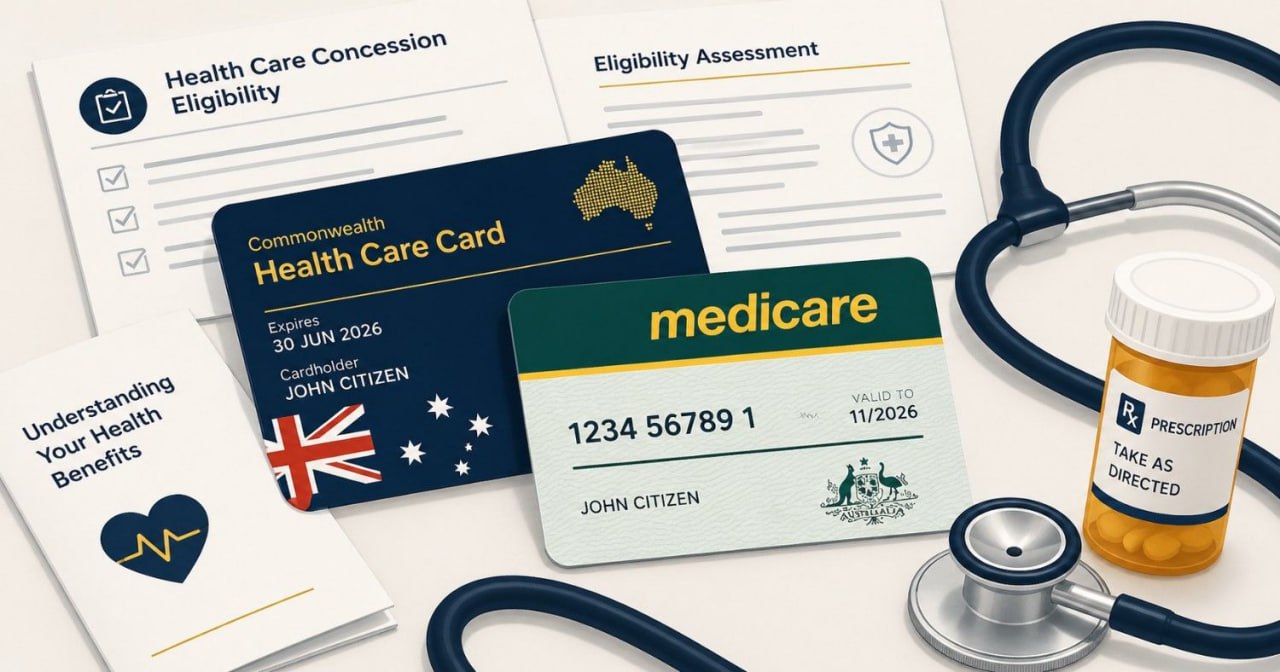
Fact-checked against Services Australia — Concession and health care cards on 2026-04-25.
Government health benefits in Australia don’t stop at Medicare. Behind it sits a whole layer of concession and health care cards run by Services Australia, and each one has its own eligibility rules, income tests, and perks. Plenty of Australians who’d qualify for at least one of these cards never bother to apply. Sometimes they’ve never heard of the card. More often they figure it’s “for someone else” and move on. But here’s the part people miss: the rules are mostly about income, not about being on welfare, and loads of folks on perfectly ordinary wages would tick the box for the Low Income Health Care Card if they checked.
Why “government health benefits” is broader than Medicare
Medicare is the universal one – everyone in the system gets it, and we cover the rules for that in our Medicare eligibility article. The concession cards are a different beast. They sit on top of Medicare, they’re run by Services Australia, and each comes with its own card and its own way of deciding who’s in.
Most of the cards do roughly the same job: they knock down your PBS prescription co-payments, get you across the Medicare Safety Net threshold faster, and unlock a long list of state-level concessions on transport, utilities, council rates, and the like. Where the cards really differ is in who can get one and which extras come attached.
If you want the full, current list, the Services Australia concession and health care cards page is the place to start.
The four cards at a glance
Before we go card by card, here’s how the four main cards stack up against each other. Everything in this table comes straight from the sections below.
| Card | Who it’s for | How you get it | Means tested? |
|---|---|---|---|
| Health Care Card (HCC) | People on certain Centrelink payments – JobSeeker, Youth Allowance, Parenting Payment, Carer Payment, Disability Support Pension, and others | Issued automatically with the underlying payment | Via the underlying payment |
| Low Income Health Care Card (LIHCC) | Australian residents on low or average incomes, with no welfare payment needed | You apply (online through myGov) | Yes – gross income over the past 8 weeks |
| Pensioner Concession Card (PCC) | People on the Age Pension, Disability Support Pension, and certain other pension-type payments | Issued automatically with the qualifying pension | Via the underlying pension |
| Commonwealth Seniors Health Card (CSHC) | Self-funded retirees of Age Pension age who don’t get the Age Pension | You apply | Income-tested only, not asset-tested |
The Health Care Card
The Health Care Card (HCC) lands in your hands automatically if you’re on certain Centrelink payments – JobSeeker, Youth Allowance, Parenting Payment, Carer Payment, Disability Support Pension, and a few others. You don’t fill in a separate form for it in most cases. It just comes with the payment you’re already getting.
That means the eligibility question is really about the payment underneath it, which we cover in our Centrelink eligibility article. Get the payment, get the card.
What the HCC provides:
- Concessional PBS prescription co-payments
- Lower Medicare Safety Net thresholds (faster threshold-based protection)
- Eligibility for state and territory concessions – public transport, utility rebates, council rates discounts, and others
- Some private-sector discounts (varying by retailer and provider)
The card runs for a set period and renews itself while the payment keeps going. Lose the payment and you lose the card with it. For the current detail, see the Services Australia Health Care Card page.
The Low Income Health Care Card
The Low Income Health Care Card (LIHCC) is the one to pay attention to. It’s a separate card open to Australian residents whose income sits below a published threshold over the previous eight weeks – and crucially, you don’t need to be on any other Centrelink payment to get it. This is the card most working Australians on average or below-average incomes would actually qualify for, and most of them never realise it.
The eligibility test:
- Australian residence and presence in Australia
- Gross income (combined for couples) below the LIHCC weekly threshold over the past 8 weeks
- Not currently receiving most other concession-card-issuing payments (since those would already provide a card)
The income threshold here is its own thing – more generous than most of the Centrelink payment thresholds. Services Australia publishes it and indexes it from time to time. Workers between jobs, parents who’ve dropped their hours, students juggling part-time work, the self-employed with income that bounces around month to month – all of them commonly qualify, and a lot of them never put in an application.
What you get is much the same as the HCC on the PBS and Safety Net side. State concessions are where it gets patchy: some states honour the LIHCC for the same concessions as the HCC, others don’t.
The Pensioner Concession Card
The Pensioner Concession Card (PCC) goes to people on the Age Pension, the Disability Support Pension, and certain other pension-type payments. Of all the cards, it’s usually the most generous – both for what it gets you and for how widely it’s recognised.
You don’t apply for it on its own. It flows automatically once you’re on a qualifying pension. The Age Pension itself comes up in our broader retirement systems article and our Centrelink-eligibility article.
On top of the standard concessions, the PCC typically gets you:
- Concessional PBS co-payments
- Faster Medicare Safety Net thresholds
- Bulk-billing for some GP services in some practices
- Broader recognition of state concessions, including transport and utility rebates
- Eligibility for some federal concessions not available through other cards
Like the others, it’s issued for a set period and renews while the pension keeps running.
The Commonwealth Seniors Health Card
The Commonwealth Seniors Health Card (CSHC) is built for self-funded retirees who are of Age Pension age but don’t actually get the Age Pension – usually because their income or assets push them past the means-test thresholds. The CSHC runs its own income test, based on adjusted taxable income, and that figure includes deemed income from financial assets.
Here’s the part that catches people out: the CSHC is income-tested but not asset-tested. That’s a big difference from the Age Pension. So if you own a sizeable home (which sits outside the assets test) or you’re holding a decent chunk of super in an account-based pension, you can still qualify for the CSHC even with substantial financial resources behind you.
Benefits include:
- Concessional PBS co-payments
- Various state-level seniors concessions
- Sometimes additional federal supplements
For self-funded retirees, the CSHC has long been a handy piece of the retirement-income puzzle, and it’s worth a look around or just after you hit Age Pension age.
What each card actually saves you
How much a card is worth comes down to how you use it. Some benefits barely move the needle for one household and save another a small fortune. These are the ones that consistently pull their weight across most of the cards:
- PBS prescription co-payment – the difference between the standard and concessional co-payment, multiplied by prescriptions per year. For households on regular medication, this can add up substantially.
- Medicare Safety Net – concession-card holders cross the Safety Net threshold at a lower amount, accelerating the higher-rebate protection
- State public transport – concession fares in most cities, often around half the standard rate
- Utility rebates – vary by state but commonly several hundred dollars per year
- Council rates concessions – for property-owning cardholders in some states
- Various private-sector discounts – varies widely
The PBS side of this sits on top of the universal Pharmaceutical Benefits Scheme framework. The Medicare side runs alongside the broader Medicare framework.
How the savings stack up
Here’s the same list as a quick reference, sorted from the benefit most cardholders use to the ones that are more situational. Every figure here is exactly as described above – nothing added.
| Benefit | Roughly worth | Who it helps most |
|---|---|---|
| PBS prescription co-payment | The gap between the standard and concessional co-payment, multiplied by scripts per year | Households on regular medication |
| State public transport | Often around half the standard fare | Regular public-transport users in most cities |
| Utility rebates | Commonly several hundred dollars per year (varies by state) | Cardholders in states that offer them |
| Medicare Safety Net | Cross the threshold at a lower amount, bringing forward higher-rebate protection | People with high yearly medical costs |
| Council rates concessions | Varies by state | Property-owning cardholders in some states |
| Private-sector discounts | Varies widely | Depends on the retailer or provider |
Frequently asked questions
What government health benefit cards are available in Australia?
The main cards are the Health Care Card (for low-income earners and welfare recipients), the Low Income Health Care Card (a separate income-tested card not requiring a welfare payment), the Pensioner Concession Card (for Age Pension and other pension recipients), and the Commonwealth Seniors Health Card (for older Australians not on the Age Pension but within income limits).
Who is eligible for a Low Income Health Care Card?
Low Income Health Care Cards are available to Australian residents whose gross income falls below a published weekly threshold over the previous eight weeks. The thresholds vary by family situation and are different from the Centrelink income tests. The card is issued without requiring receipt of any other Centrelink payment.
Do health care cards cover all medical costs?
No. Health care cards reduce specific costs — concessional PBS prescription co-payments, faster Medicare Safety Net thresholds, some state-specific concessions on transport, utilities, and dental care. They don’t eliminate gap fees on private GP or specialist consultations and don’t replace private health insurance.
The eligibility check most people don’t do but should
If you do one thing after reading this, make it this: look up the Low Income Health Care Card threshold and hold it against your actual gross income over the past eight weeks. The threshold is more forgiving than most people assume, and the things that temporarily knock your income down – parental leave, a gap between jobs, a year spent studying, a stretch of casual-only work – can quietly land you in eligible territory without you noticing.
What matters most, in order
If you’re not sure where to start, work through it like this:
- Check whether you’re already covered. If you’re on a qualifying Centrelink payment or pension, your HCC or PCC is issued automatically – there’s nothing to apply for.
- If not, run the LIHCC income check. Add up your gross income (combined, if you’re a couple) over the past eight weeks and compare it to the published weekly threshold.
- If you’re of Age Pension age but not on the pension, look at the CSHC instead. It uses adjusted taxable income including deemed income, and it’s income-tested but not asset-tested.
- Apply through myGov. It’s free, it’s processed online, and you can let it lapse if your circumstances change.
- Weigh up the benefits. For households with regular medication or kids, the savings can comfortably outweigh the small effort of applying.
It costs nothing to apply, it’s processed online through myGov, and you can cancel it or let it lapse if things change. For households with regular medication or kids in particular, what you save can easily outweigh the small effort of filling in the form.
If you’re older and not on the Age Pension, the same thinking applies to the Commonwealth Seniors Health Card. Its income test runs on adjusted taxable income, deemed income from financial assets included, and plenty of self-funded retirees sitting on solid home equity but a modest income flow would qualify – and never apply.