
Fact-checked against Fair Work Ombudsman — Hours of work, breaks and rosters on 2026-04-25.
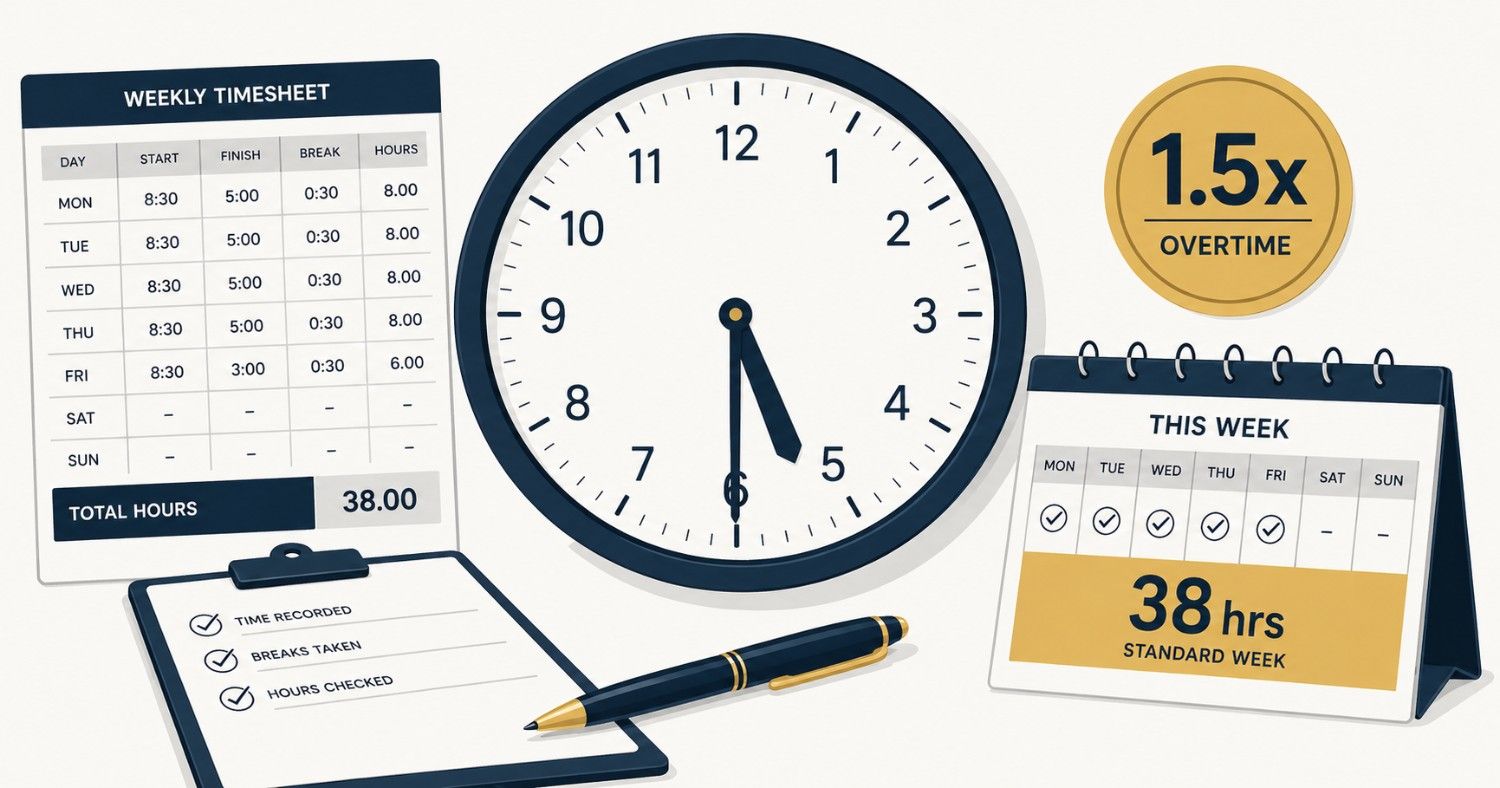
Most full-time employees in Australia work close to 38 hours a week, but overtime patterns swing wildly from one industry to the next. And in some of those industries, a fair chunk of the overtime people work never gets paid – usually because nobody’s clear on who’s entitled to overtime, or when it kicks in. The frustrating part is that the rules are actually clearer than the average workplace makes them feel. Find the award that covers your role and most “is this overtime?” arguments sort themselves out in minutes.
The framework – National Employment Standards plus awards
Australian work-hours rules sit on two levels. The National Employment Standards (NES) – set out in the Fair Work Act – are the floor: minimum protections that apply to every employee in the national workplace relations system. Modern awards then sit on top, adding detail and stronger protections tailored to each industry and occupation. Think of the NES as the baseline and the award as the fine print for your specific job.
The NES provisions that matter for hours are:
- Maximum weekly hours of work – 38 hours for full-time employees, plus reasonable additional hours
- Right to refuse unreasonable additional hours
- Right to request flexible working arrangements in some circumstances
- Public holidays
- Annual leave and personal leave
The award layer does the heavy lifting. Awards spell out your ordinary hours of work, the span of hours (the times of day when ordinary hours can be scheduled), penalty rates for unsocial hours, overtime triggers, and breaks. The Fair Work Ombudsman’s hours of work, breaks and rosters page covers both layers.
Maximum weekly hours and “reasonable additional hours”
The Fair Work Act caps ordinary hours at 38 a week for full-time employees. Past that, an employer can ask you to work “reasonable additional hours” – but reasonableness is a real test, not a box-tick. The word does actual work here.
Here’s what the Act weighs when deciding whether extra hours are reasonable:
- Risk to health and safety from working additional hours
- The employee’s personal circumstances, including family responsibilities
- The needs of the workplace
- Whether overtime pay or time off in lieu compensates for the additional hours
- Notice given by the employer
- Notice given by the employee of any inability to work additional hours
- Usual patterns of work in the industry
- The employee’s role, level, and responsibilities
If additional hours would be unreasonable, you can say no – and turning them down on those grounds is not a breach of your contract. In practice, parents, carers, and people in safety-sensitive roles lean on this protection more than most, but it applies to everyone.
For more detail on the maximum weekly hours rules, the Fair Work Ombudsman’s maximum weekly hours page is the authoritative source.
Ordinary hours and how they get scheduled
“Ordinary hours” is a technical term in awards. It’s the hours you can be rostered at base rates of pay, before overtime triggers. Awards set out:
- The number of ordinary hours per week (typically 38 for full-time)
- The span of hours – the times of day during which ordinary hours can fall (e.g., Monday-Friday 7am to 7pm in many awards)
- Whether ordinary hours can be averaged over multiple weeks
- How shift work and rotating rosters are treated
Work scheduled outside the span of ordinary hours – early starts, late finishes, weekends – usually attracts penalty rates or overtime rates, depending on what your award says. So a Saturday shift might be plain ordinary hours under one award and a penalty-rate shift under another. It all comes down to how that award defines its span.
Overtime – when it kicks in and how it’s paid
Overtime is hours worked beyond your ordinary hours, or outside the span of ordinary hours, where your award or agreement says overtime pay applies. Both the triggers and the rates vary a lot between industries, so the answer for your job lives in your award.
Common overtime structures:
- Time-and-a-half for the first few hours of overtime each day or week
- Double-time after that, or after specific hour thresholds
- Different rates for weekends, public holidays, and night shifts that already attract penalty rates
- Minimum overtime payments (e.g., minimum two hours when called in for overtime)
This is where entitlements quietly go missing. The classic pattern: someone covered by an award works a couple of hours past their finish time, the boss waves it off as “just staying back to wrap up”, and the overtime rate that should have applied never gets paid. Do that week after week and it adds up to real money.
Whether you’re entitled to overtime at all comes down to the award or agreement covering your role. Some salaried staff are on an “all-up” rate meant to cover reasonable overtime – but that only holds if the award and the contract are actually set up to allow it. The award pay rates page covers how overtime rates are calculated for specific awards.
An illustrative example of how TOIL is banked
Illustrative only. Say you work one hour of overtime, and your award pays that first hour at time-and-a-half. If you take time off in lieu instead of the cash, it’s banked at the same rate the overtime would have paid – so that one hour becomes 1.5 hours of TOIL, not 1 hour. The figures here (one hour, time-and-a-half, 1.5 hours) come straight from the rates and rules described in this article; your own award sets the real numbers for your role.
Time off in lieu and other arrangements
Time off in lieu (TOIL) lets you take paid time off for overtime instead of being paid out for it. It can suit both sides, but it’s not a free-for-all – it’s regulated:
- Some awards explicitly allow TOIL with specific conditions
- Where allowed, TOIL is usually banked at the same rate that overtime pay would have applied (so an hour of overtime at time-and-a-half becomes 1.5 hours of TOIL, not 1 hour)
- Some awards require TOIL to be taken within a defined period or paid out
- Other arrangements – averaging hours, banked time – are also defined in some awards
TOIL works fine when it’s written down and tracked. When it’s informal, it breeds disputes. If you’re told to “make up the time later” with nothing in writing, the arrangement has a way of being forgotten – or flatly denied.
When the rules get pushed and what happens
The Fair Work Ombudsman investigates wage-and-hour complaints, and the same few problems come up again and again: unpaid overtime, missed breaks, public holiday entitlements left unpaid, and incorrect classification – treating award-covered employees as if they weren’t, or slotting them into a lower classification than the work deserves.
When that happens, recovery usually means back-payment plus penalties, and in the worst cases the employer gets named publicly. The ombudsman has steadily stepped up its compliance work over recent years.
If you’re thinking about raising a concern, here’s the practical order to work through it:
- Document the hours you worked – keep your own record, separate from the employer’s systems
- Look up the award covering your role on the Fair Work Ombudsman pay calculator
- Compare your actual pay to the award rate for the hours you worked
- If the gap is small or could be a payroll slip-up, raise it with your employer in writing first
- If it isn’t resolved, contact the Fair Work Ombudsman
Two protections, side by side
It’s easy to confuse the maximum-hours protection with the overtime entitlement, but they answer different questions. This table pulls together the facts already covered above:
| Feature | Maximum weekly hours (NES) | Overtime pay (award/agreement) |
|---|---|---|
| Where it comes from | National Employment Standards, set in the Fair Work Act | The modern award or registered agreement covering the role |
| The core number | 38 ordinary hours a week for full-time, plus reasonable additional hours | Often time-and-a-half for the first few hours, then double-time |
| Who it applies to | All employees in the national workplace relations system | Only roles covered by an award or agreement that includes overtime |
| Can you refuse / opt out? | You can refuse additional hours that are unreasonable, with no breach of contract | Not about refusal – it’s about being paid correctly for hours already worked |
| What to check | Whether the extra hours are reasonable, using the Act’s factors | Whether your award includes overtime, and at what rate |
Frequently asked questions
What are the maximum work hours in Australia?
The Fair Work Act sets a maximum of 38 ordinary hours per week for full-time employees, plus reasonable additional hours. What counts as ‘reasonable’ depends on factors including the employee’s personal circumstances, workplace risks, the role, and whether the additional hours involve overtime pay. Anything beyond reasonable can be refused without breaching the contract.
How is overtime paid in Australia?
Overtime rates depend on the modern award or registered agreement covering the role. Common rates are time-and-a-half for the first few hours of overtime and double-time after that. Some awards specify different patterns. Overtime entitlements only apply if the role is covered by an award or agreement that includes them — not all employment contracts include overtime pay.
Can my employer require me to work overtime?
Employers can require reasonable additional hours, but employees can refuse hours that would be unreasonable. The reasonableness test considers personal circumstances, workplace safety, role expectations, and notice given. Repeated demands for unreasonable hours can be raised with the Fair Work Ombudsman.
What to actually check on your own pay
When pay disputes get sorted, they almost always come back to the same three checks. First, find out which award covers your role – plenty of people have no idea, and looking it up on the Fair Work Ombudsman pay calculator takes a few minutes. Second, read what that award says about hours, overtime, and breaks for your classification, because the differences between awards are real and they cost money. Third, work out whether your actual pay matches what the award produces for the hours you actually worked.
Run those three checks once a year – or any time something feels off – and you’ve covered most of what separates workers who get paid correctly from those who quietly rack up underpayment over years. The Fair Work Ombudsman’s pay and wages hub is built for exactly this, and it’s free.
If you’re on a visa, there’s an extra layer: how your visa conditions interact with these workplace protections. We cover that in our working rights article.