
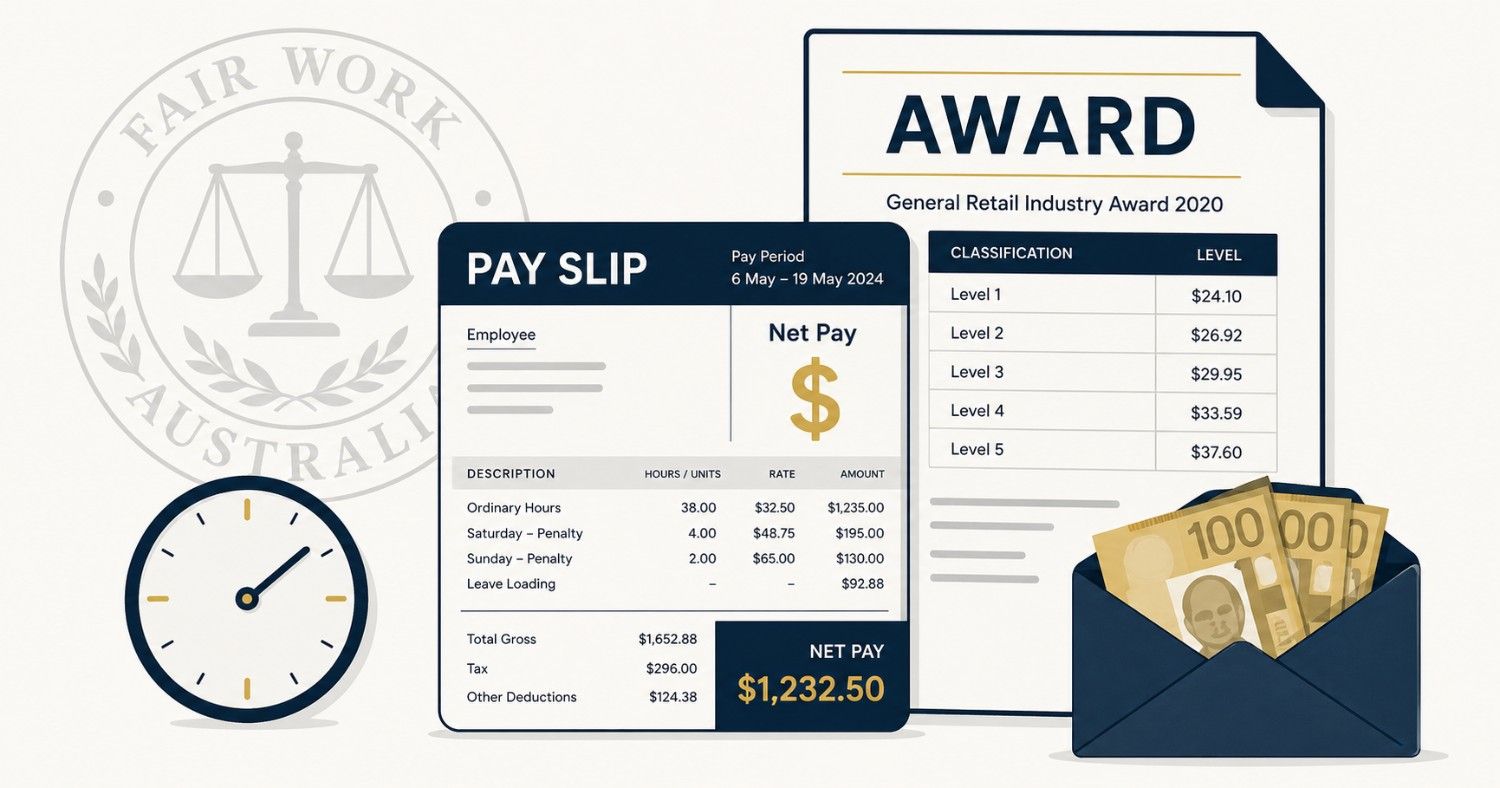
Fact-checked against Fair Work Ombudsman — Minimum wages on 2026-04-25.
Ask “what’s the minimum wage in Australia?” and you’d expect one number back. You won’t get one. There are around 122 modern awards, and each sets its own minimum rates by classification. On top of that sits the National Minimum Wage as a default for the small group no award covers, plus casual loadings, weekend penalty rates, junior rates and apprentice rates. So the figure most people actually get paid is almost never the headline National Minimum Wage you see in the news.
Why “the minimum wage” is rarely a single number
Australia’s wage floor is built on awards, not on one national figure. Modern awards cover most industries and occupations – retail, hospitality, healthcare, construction, manufacturing and the rest – and each award has its own ladder of classification levels with a minimum rate at every rung. That means a junior retail worker, a senior office worker and an aged-care personal carer are all on different numbers, each set by their own award.
You can find the full list of modern awards and minimum rates on the Fair Work Ombudsman’s minimum wages page. The most reliable way to find the rate for a specific role is the ombudsman’s pay calculator. Use it. It beats relying on the headline National Minimum Wage every time.
The part that rarely gets said plainly: the National Minimum Wage only applies to a small share of workers. Most employees are covered by an award, and the award’s minimum rate is what really sets their wage floor.
The National Minimum Wage
The National Minimum Wage (NMW) is the default floor for award- and agreement-free employees – people whose work doesn’t fall under any modern award and who aren’t covered by a registered enterprise agreement. The Fair Work Commission reviews it every year and any change kicks in from 1 July.
Who tends to land on the NMW rather than an award:
- Some senior management or professional roles outside award coverage
- Specialised roles that fall outside any specific award classification
- Some industries where awards have been phased out and not replaced
For most people in standard jobs, the number that matters is their award’s minimum rate, not the NMW. Think of the NMW as a backstop – the floor no wage can drop below when no award applies.
Modern awards and award minimum rates
Modern awards are industry- or occupation-based instruments that set minimum pay and conditions for the employees in those industries and occupations. Australia has around 122 of them, and the Fair Work Commission maintains every one.
Each award carries:
- Multiple classification levels with different minimum rates
- Different rates for full-time, part-time, and casual employees
- Penalty rates for weekends, public holidays, and overtime
- Allowances for specific situations (uniform, tool, travel, first-aid)
- Junior rates for under-21 employees in some industries
- Apprentice and trainee rates
Two people doing different jobs for the same employer can sit on different awards, and so on different minimum rates. That’s exactly why “what’s my minimum wage?” can’t be answered until you know the role and its award classification.
Here’s how those layers stack up, using only the categories above:
| Pay element | What it covers | Set by |
|---|---|---|
| Classification rate | Base minimum for the level you work at | The relevant modern award |
| Employment-type rate | Different rates for full-time, part-time and casual | The relevant modern award |
| Penalty rates | Weekends, public holidays and overtime | The relevant modern award |
| Allowances | Uniform, tool, travel, first-aid and similar | The relevant modern award |
| Junior rates | Under-21 employees in some industries | The relevant modern award |
| Apprentice and trainee rates | Apprentices and trainees | The relevant modern award |
How the Fair Work Commission decides
The Fair Work Commission runs an Annual Wage Review every year and weighs up submissions from unions, employer groups, government and others. What it looks at:
- Living standards and the needs of low-paid employees
- Productivity and economic conditions
- Inflation
- Workforce participation
- The capacity of the system to absorb wage increases
The decision takes effect from 1 July. It usually lifts the NMW and award minimum rates by the same percentage, though individual awards can be reviewed on their own when there’s a specific case for it.
The process is technical, but at heart it’s a balancing act between cost-of-living pressure and what the economy can carry. The decisions are public, and they’re worth reading when they land each year – they spell out what changed and why.
Casual loading and the higher casual minimum
Casuals get the minimum award rate plus a casual loading – typically 25% above the equivalent permanent rate. That loading is there to make up for what casuals miss out on: paid leave, redundancy entitlements and other permanent-employment protections.
So a casual minimum wage is the relevant award rate x 1.25 (or whatever loading the award sets). For a casual on the headline National Minimum Wage equivalent, the real minimum is the NMW x 1.25.
And casual loadings sit on top of penalty rates, not instead of them. A casual working a Sunday could earn the base award rate x casual loading x Sunday penalty multiplier, all stacked together. Enter the role, classification and shift type into the Fair Work Ombudsman pay calculator and it works that out for you.
Worked example – illustrative only. Take a casual whose award classification matches the National Minimum Wage equivalent and add the 25% casual loading from this section. The casual minimum becomes NMW x 1.25. Now put them on a Sunday shift, and the Sunday penalty multiplier stacks on top of that loaded rate – base award rate x casual loading x Sunday penalty multiplier. The exact dollar figures depend on the current NMW and the award’s penalty, which is precisely why the pay calculator is the tool to confirm them.
How underpayment actually gets recovered
Underpaying award rates is one of the more common workplace-rights problems in Australia. The Fair Work Ombudsman investigates underpayment complaints, and recovering the money can involve:
- Back-payment of the difference between actual and correct rates
- Compensation for any associated losses
- Penalties against the employer for breaches
- Public disclosure of breaches in some cases
Over the past decade the Fair Work Ombudsman has steadily ramped up its compliance and enforcement work, including high-profile cases where large employers were found to have systematically underpaid workers for years. The ombudsman’s pay and wages hub walks you through checking your pay against the award and starting a complaint.
If you’re on a visa, there’s an extra layer to know about. Our working rights article covers how visa conditions interact with these wage protections.
Frequently asked questions
What is the minimum wage in Australia?
Australia has a National Minimum Wage set annually by the Fair Work Commission. It applies to employees not covered by a modern award or registered agreement. Most employees are actually covered by an award with its own minimum rates, which can be higher than the National Minimum Wage. The current National Minimum Wage figure is published on the Fair Work Ombudsman site.
Are casuals paid the same minimum wage?
Casuals are paid at minimum award rates plus a casual loading — typically 25% above the equivalent permanent rate — to compensate for not having paid leave. So a casual earning the minimum casual wage in their award is earning the award minimum plus loading, which is higher than the bare permanent minimum.
Who sets the minimum wage in Australia?
The Fair Work Commission (FWC) sets and reviews the National Minimum Wage and award minimum rates each year through an Annual Wage Review. The Fair Work Ombudsman is a separate body that enforces compliance with those rates and other workplace laws.
The single number to actually look up for your situation
Once a year, do one thing: look up your exact award classification on the Fair Work Ombudsman pay calculator. Feed it your role, industry, classification level and employment type, and it returns the current minimum rate with any loadings, allowances and penalty rates baked in. That figure is your actual minimum wage for that role – far more useful than the headline National Minimum Wage.
The headline NMW makes the news, but it isn’t the number most workers should measure themselves against. The award rate is. And since rates change every 1 July, a once-a-year lookup is a smart habit – especially for casuals and part-timers, whose pay can drift quietly through the year if an employer is slow to update payroll.
If you want a quick priority order, here’s what matters most, in order:
- Find the modern award and classification level that fits your role – that’s where your real minimum lives.
- Check your employment type (full-time, part-time or casual), because the rate differs for each.
- If you’re casual, confirm the casual loading (typically 25%) is applied on top.
- Add any penalty rates for weekends, public holidays or overtime you actually work.
- Add any allowances that apply (uniform, tool, travel, first-aid).
- Re-run the pay calculator after 1 July each year, since rates change then.
- Only fall back to the National Minimum Wage if no award and no registered agreement covers you.