
Fact-checked against StudyAssist — HELP loans overview on 2026-04-25.
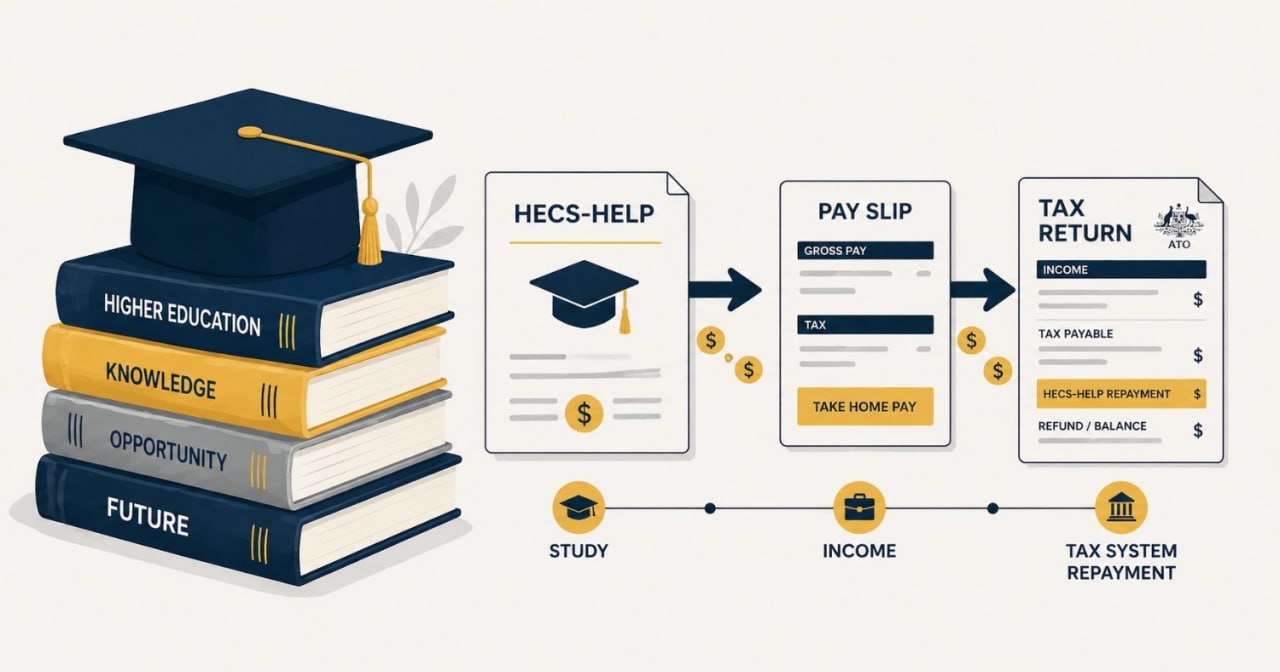
HECS-HELP quietly funds a big chunk of Australian higher education, and it’s also one of the most misunderstood things in personal finance. The trap is treating it like a bank loan. It isn’t one. HECS-HELP is a federal income-contingent loan, and you repay it through the tax system based on what you earn. That single difference changes how it behaves at every step – so the way you’d handle a car loan or a credit card simply doesn’t map onto it.
What HECS-HELP actually is
HECS-HELP is a federal student loan for eligible Commonwealth-supported students at approved Australian higher-education providers. Here’s the mechanics: the government pays your student-contribution amount straight to your provider, and you take on a debt to the Commonwealth for that same amount. You pay nothing upfront. The whole fee just gets added to a HELP balance with your name on it.
The repayment side is where it stops looking like a normal loan. There are no fixed monthly payments. Instead, repayments are worked out as a percentage of your taxable income above a published threshold, they’re collected automatically through the tax system, and they only kick in once you earn enough to trigger them. The full ruleset sits on the StudyAssist HECS-HELP page.
So what does that look like in real life? If you’re not earning above the threshold, you make no compulsory repayments at all. The debt just sits there, gets indexed once a year, and waits for your income to climb. That’s deliberate. The system is built to scale repayments to your capacity to pay – not to demand a set figure no matter your circumstances.
The wider HELP loan family
HECS-HELP gets all the attention, but HELP is really a family of schemes. Each one covers a slightly different study situation:
- HECS-HELP — for Commonwealth-supported students at approved higher-education providers
- FEE-HELP — for fee-paying students at approved providers (typically postgraduate or private institutions)
- SA-HELP — covers the student services and amenities fee
- OS-HELP — for eligible students undertaking part of their study overseas
- VET Student Loan — for vocational education and training (VET) at approved providers
The key thing to grasp: as far as the ATO is concerned, all of these roll up into one single HELP debt, repaid the same way through the tax system. What differs is eligibility and when you’d use each one. The StudyAssist HELP loans overview walks through each scheme in detail.
Here’s the same list as a quick comparison, so you can see at a glance who each scheme is for and what it pays for:
| Scheme | Who it’s for | What it covers |
|---|---|---|
| HECS-HELP | Commonwealth-supported students at approved higher-education providers | The student-contribution portion of the course |
| FEE-HELP | Fee-paying students (typically postgraduate or private institutions) | Tuition fees at approved providers |
| SA-HELP | Eligible students charged the SSAF | The student services and amenities fee |
| OS-HELP | Eligible students studying part of their course overseas | Overseas study costs |
| VET Student Loan | Vocational education and training students at approved providers | VET course fees |
All five roll up into one HELP debt at the ATO and are repaid the same way.
How taking out the loan works
Taking out a HELP loan is easier than most people expect – and that ease is exactly why a lot of students don’t notice how much they’re borrowing until much later. You fill in a Commonwealth Assistance Form when you enrol, your provider applies the loan to the student-contribution part of the course, and the government pays the provider directly.
No credit check. No interest in the usual sense. No collateral. To be eligible you need to meet the residency requirements and be enrolled in an approved course at an approved provider – the eligibility detail is covered in the eligibility-focused articles on this site, and in the tax-return lodgment article where it touches annual reporting.
The debt grows each semester or term as new charges land on it. While you’re studying, there’s no running statement beyond the Commonwealth Assistance Notice you get each study period. That’s why so many students are genuinely shocked by their total balance at the end of a degree – it builds up without ever showing up on a monthly bill.
Indexation — what it is, what it isn’t
HELP debts are indexed on 1 June each year. Indexation isn’t interest. It’s an adjustment that keeps the real value of your debt steady against inflation, applied at a published rate. That rate has historically tracked the Consumer Price Index, though the exact formula has changed over the years.
Two practical points are worth getting straight:
- Indexation applies to whatever balance is outstanding on 1 June. Voluntary repayments made before that date reduce the indexed amount; payments made after don’t apply to that year’s indexation.
- Compulsory repayments through the tax system are credited at end of financial year. So a graduate’s PAYG-withheld amounts during a financial year aren’t applied to the HELP balance until the tax return is processed — meaning indexation can apply to amounts the borrower has effectively already paid through the year.
You’ll find the current and historical indexation rates on the ATO’s study and training support loans page. Recent rates have run well above the long-run average, which is what prompted some of the legislative changes – so it’s worth checking the figure for the specific year you care about.
Repayments through the tax system
Compulsory repayments run through the income-tax system. Once you tell your employer you have a HELP debt (via the TFN declaration form), they withhold an extra amount on top of your ordinary PAYG tax. That withheld money goes to the ATO and gets reconciled against what you actually owe when you lodge your tax return.
The thresholds and rates are published on the ATO’s repayment thresholds page. Two things to know:
- The minimum threshold is the income level at which any compulsory repayment kicks in. Below that, no repayment is required.
- The repayment rate scales with income — higher income brackets pay a larger percentage of total income (not just the amount above the threshold).
Because everything keys off your taxable income, your repayments move around with your employment status, whether you’ve got more than one job, your deductions, and when you lodge. The TFN article covers the upstream piece – how this gets set up when you first start a job.
Living overseas with a HELP debt
Moving overseas doesn’t make a HELP debt disappear. Since 2017, Australians living overseas have had to report their worldwide income to the ATO each year and make compulsory repayments on it, exactly as a resident would.
You do the reporting once a year through an ATO online process. Miss it and you can cop penalties. And the obligation sticks regardless of whether you think of yourself as an Australian tax resident – the HELP repayment rules use a different test from tax residency, which we unpack in our tax residency article.
Frequently asked questions
Do I have to repay my HECS-HELP loan if I move overseas?
Yes. Australians with HELP debts living overseas are required to report worldwide income to the ATO and make compulsory repayments based on income, the same way as residents. The reporting is done annually through the ATO’s overseas income disclosure process, and missing it can lead to penalties.
How is HECS-HELP indexed each year?
HELP loan balances are indexed on 1 June each year using a published indexation rate, historically tied to CPI. Indexation isn’t interest in the conventional sense — it preserves the real value of the debt. The current rate is published annually on the StudyAssist and ATO sites.
Can I make voluntary repayments to reduce my HELP debt?
Yes. Voluntary repayments can be made at any time and reduce the debt before indexation is applied each June. Whether voluntary repayments are financially worthwhile depends on personal circumstances — comparing the indexation rate to alternative uses of the money is the standard analysis.
The single thing most graduates miss about HECS-HELP
The one thing most graduates miss is the timing mismatch between PAYG withholding and when your HELP balance actually drops. The money your employer withholds for HELP doesn’t reduce your balance during the financial year. It sits in an account at the ATO until you lodge your return. So you can watch your PAYG summaries show a big chunk of HELP withholding and still cop substantial indexation on the same balance, both in the same year.
If you genuinely want to minimise indexation, the practical move is to make voluntary repayments before 1 June each year, using money that would otherwise be withheld across the year anyway. For borrowers who can manage that upfront timing shift, the arithmetic produces a noticeably lower long-term debt – and the StudyAssist and ATO sites have calculators to model your own case.
In order: what matters most when you’re managing a HELP debt
- Know the 1 June date. Indexation hits whatever balance is outstanding on that day, so timing is everything.
- Understand the threshold. Below the minimum threshold, no compulsory repayment is required; above it, repayments come out automatically through the tax system.
- Tell your employer about the debt. Flag it on your TFN declaration so the right amount is withheld from the start.
- Watch the timing mismatch. PAYG-withheld amounts aren’t credited to your balance until your return is processed, so they don’t shield you from that year’s indexation.
- Consider a voluntary repayment before 1 June. A payment made before that date reduces the balance that gets indexed; one made after doesn’t.
- If you head overseas, keep reporting. Since 2017 the obligation to report worldwide income and repay continues from abroad.
Old system vs new marginal system — same income, different repayment
The shift to the marginal repayment system from 1 July 2025 changed how much graduates pay at every income level. Here’s the actual difference at common income points.
| Annual income | Old system repayment* | New marginal repayment | Difference |
|---|---|---|---|
| $50,000 | $0 (below threshold) | $0 | No change |
| $60,000 | $600 (1% × $60,000) | $0 (below new threshold) | −$600 |
| $70,000 | $1,750 (2.5% × $70,000) | $450 (15c × $3,000) | −$1,300 |
| $85,000 | $3,400 (4% × $85,000) | $2,700 (15c × $18,000) | −$700 |
| $100,000 | $6,000 (6% × $100,000) | $4,950 (15c × $33,000) | −$1,050 |
| $130,000 | $10,400 (8% × $130,000) | $9,550 ($8,700 + 17c × $5,000) | −$850 |
| $180,000 | $18,000 (10% × $180,000) | $18,000 (10% × $180,000) | No change |
* Old-system rates shown are illustrative — they used different brackets each year. The example here uses the FY 2024-25 final-year rates: 1% from $54,435, scaling up through 18 brackets to 10% above ~$162,336.
The pattern: the new marginal system reduces compulsory repayments at every income level up to about $179,000. The biggest beneficiaries are people earning between $54,000 and $90,000 — who under the old system paid 1–4.5% of their entire taxable income, but under the new system pay 15 cents only on income above $67,000.
Why this matters for budgeting: if your salary falls in the $60–90k band, your take-home pay just went up by $600–$1,300/year compared to FY 2024-25, before considering the 20% one-off debt cut. The cliff effect at each old threshold has been replaced with a smooth marginal calculation, so a small pay rise no longer triggers a disproportionate jump in compulsory repayment.