
Fact-checked against privatehealth.gov.au on 2026-04-25.
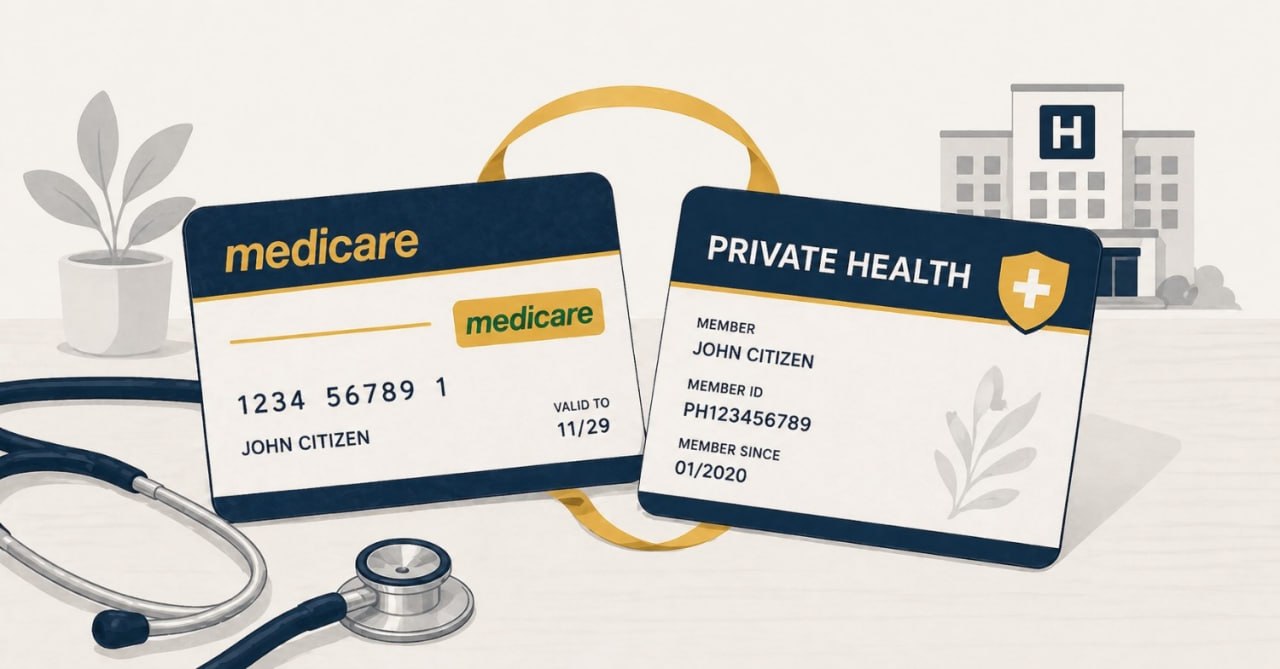
About 45% of Australians hold some form of private health insurance, and that figure has drifted up and down over the past two decades as the Medicare Levy Surcharge and Lifetime Health Cover loading have given higher earners a tax reason to take cover out. Here’s the part most people miss: private cover is built to sit alongside Medicare, not replace it. Get your head around how the two fit together and you’ll know pretty quickly whether private cover is real value for your household – or just another line on the budget.
The two main types of private cover
Private health insurance in Australia comes in two main flavours. You can buy them separately or bundle them as a combined policy. The federal comparison portal at privatehealth.gov.au is the go-to consumer source for both.
Hospital cover
Hospital cover pays toward private treatment in hospital – the accommodation, theatre fees, and the gap between Medicare’s in-hospital rebate and what the hospital actually charges. It lets you pick your own doctor and hospital for elective procedures. It’s also the type of cover that affects the Medicare Levy Surcharge.
Extras cover (general treatment)
Extras cover chips in on the out-of-hospital services Medicare either doesn’t touch or barely covers – think dental, optical, physio, and the rest of the allied health list. Each service category has its own annual limit, and anything you don’t use doesn’t roll over to next year.
The two do genuinely different jobs. Hospital cover is catastrophic protection plus choice of doctor and hospital. Extras cover is about trimming the routine out-of-pocket costs Medicare leaves on the table.
Hospital cover – what it does
Hospital cover sits on top of Medicare. When you’re treated as a private patient in hospital, Medicare pays a rebate of 75% of the relevant Medicare Benefits Schedule fee for the medical services – that’s the doctor’s component. Your hospital insurance covers the rest of that medical fee gap, subject to the policy terms, plus the accommodation and theatre costs.
Hospital policies vary a lot, and it comes down to three things:
- Excess – the upfront amount you pay per hospital admission before the insurer starts paying. A higher excess buys you a lower premium.
- Inclusions – what the policy actually covers. Basic policies leave out whole categories like heart surgery, joint replacements and pregnancy; comprehensive policies cover almost the lot.
- Restrictions – some policies cover certain treatments only as restricted services, paying minimum benefits rather than gap-style benefits. That quietly guts the practical value.
One thing hospital cover doesn’t change is your public-hospital treatment as a public patient. If you’re eligible for Medicare, you still get free public hospital care whether or not you hold private cover. The Department of Health and Aged Care’s private health insurance page sets out the policy framework.
Extras cover and annual limits
Extras cover picks up the services Medicare doesn’t – dental check-ups and fillings, optical (glasses and contact lenses), physio, chiropractic, remedial massage on some policies, and a long tail of other allied health. Each category carries its own annual limit. Hit the limit and you’re paying full freight for the rest of the year.
With extras, it tends to play out one of two ways:
- Households that use those categories regularly – routine dental, a family member on physio, kids needing glasses – usually claim back enough to cover their premiums.
- Households that rarely use them often pay more in premiums than they ever claim, sometimes by a wide margin.
At heart, extras is a budgeting tool. It smooths out predictable annual costs. It isn’t a tax product, so unlike hospital cover, whether you hold extras has no bearing on the Medicare Levy Surcharge or LHC.
The Medicare Levy Surcharge
The Medicare Levy Surcharge (MLS) is an extra tax on higher-income earners who don’t hold appropriate private hospital cover. It’s a separate thing from the standard Medicare Levy nearly everyone pays.
The MLS works in income tiers. The published thresholds live on the ATO’s Medicare and private health insurance page and on the Services Australia MLS page. Depending on your bracket, the rate is 1%, 1.25%, or 1.5% of income.
For a lot of higher earners, the MLS works out to more than a basic hospital policy would cost. So buying a low-end hospital policy purely to dodge the surcharge is common, and the maths is simple: the policy costs less than the tax it avoids. Whether it’s worth it for you depends on your income tier and what basic policies are going for that year.
Two things to keep straight here. Only hospital cover affects the MLS – extras on its own does nothing. And the cover has to meet a minimum standard set by the federal government to count.
Lifetime Health Cover loading
Lifetime Health Cover (LHC) loading is the government’s nudge to get younger Australians into private hospital cover sooner. Miss your LHC base day – 1 July after your 31st birthday – without appropriate hospital cover and you cop a 2% loading on your premiums for every year past 31, capped at 70%.
Two things about LHC matter in practice:
- The loading sticks until you’ve held continuous cover for 10 years.
- It applies to the base premium – so a 50% loading on a $200/month basic policy adds $100/month, not some flat amount across every policy.
If you reckon you’ll hold private hospital cover at some point in your life, getting in before your LHC base day usually saves you real money over the long haul. If you’ve no intention of holding private cover, LHC simply isn’t a factor – unless your circumstances change down the track.
Waiting periods and how they actually work
Waiting periods exist to stop people taking out cover only when they’re about to need a procedure. They’re set in legislation, not by individual insurers, and they apply to:
- Pre-existing conditions – typically 12 months on hospital cover.
- Pregnancy and birth-related services – typically 12 months.
- Major dental or other extras services – varies by policy and category, often 6-12 months.
- General hospital cover – typically 2 months for new claims.
Where waiting periods bite hardest is when you switch insurers. Move to a comparable level of cover with another insurer and the waiting periods you’ve already served generally carry over – but only for the equivalent service. Upgrade to a higher level of cover and the clock restarts on the upgraded portion.
So if you’re thinking of changing insurers, read the carry-over rules closely. The privatehealth.gov.au comparison tool spells this out in the policy detail.
Hospital vs extras at a glance
The two covers get muddled constantly, so here’s how they line up on the points that actually matter – all drawn straight from the rules above.
| Hospital cover | Extras cover | |
|---|---|---|
| What it pays for | In-hospital private treatment: accommodation, theatre fees, the medical fee gap | Out-of-hospital services Medicare doesn’t cover: dental, optical, physio and other allied health |
| How it’s limited | Excess per admission, plus inclusions and restrictions | Annual limit per service category; unused limits don’t roll over |
| Affects Medicare Levy Surcharge? | Yes – this is the cover that counts for the MLS | No – extras alone has no MLS effect |
| Affects LHC loading? | Yes – LHC loading applies to hospital cover premiums | No |
| Main reason to hold it | Catastrophic protection plus choice of doctor and hospital for elective surgery | Smoothing predictable, routine out-of-pocket costs |
How an LHC loading adds up (illustrative only)
Loadings sound abstract until you put a dollar figure on them. This uses only the example numbers already cited in this guide – illustrative only, not a quote for your situation.
- Take the basic policy used as the example above: $200/month.
- The loading applies to that base premium. A 50% loading means $200 x 0.50, which is $100/month on top.
- That brings the monthly premium to $300/month while the loading is in force.
- A 50% loading lands when you take out cover roughly 25 years past 31 (2% per year), and it sticks until you’ve held continuous cover for 10 years before it drops away.
The lesson isn’t the exact dollars – it’s the shape of it. The loading scales with your base premium, so the bigger the policy, the bigger the extra cost. That’s the case for getting in before your LHC base day if private cover is on the cards at all.
Frequently asked questions
Do I need private health insurance in Australia?
Not legally – Medicare provides universal cover for eligible Australians. But higher-income earners face the Medicare Levy Surcharge if they don’t hold appropriate private hospital cover, and waiting periods on private hospital cover can stretch for months. Whether private cover is worthwhile depends on income, age, and how much in-hospital private treatment a household values.
What does the Medicare Levy Surcharge cost?
The Medicare Levy Surcharge (MLS) is an additional tax on higher-income earners who don’t hold appropriate private hospital cover. The MLS is set at 1%, 1.25%, or 1.5% of taxable income depending on which income tier the taxpayer falls into. The thresholds are published on the ATO and Services Australia sites and indexed periodically.
What is the Lifetime Health Cover loading?
Lifetime Health Cover (LHC) is a 2% loading added to private hospital cover premiums for each year past age 31 that someone takes their first appropriate hospital cover. The loading caps at 70% and removes after 10 years of continuous cover. It’s designed to encourage younger people to take up private cover earlier.
The data point that decides whether private cover is worth it
There are really only four reasons private health insurance earns its keep: dodging the Medicare Levy Surcharge as a higher earner, locking in a younger LHC base premium, getting choice of doctor and hospital for elective surgery, or smoothing predictable extras costs. The economics are different for each one. Hold cover for the wrong reason – paying for hospital cover you never use, with no MLS or LHC benefit attached – and it’ll feel like money down the drain, because it is.
If you’re comparing policies, the federal portal at privatehealth.gov.au is genuinely the best place to do it. It shows the policy tier (basic, bronze, silver, gold) and what’s included or restricted in a standard format that insurer marketing never gives you straight. Plenty of households who actually sit down and compare find a much simpler basic-tier policy covers their real MLS-avoidance need for far less than what they’re paying now.
And whatever you settle on, give it a once-over every year. Premium changes, policy changes, life events and shifting MLS thresholds can all tip the balance on whether your current cover still makes sense.