
Fact-checked against Department of Education on 2026-04-25.
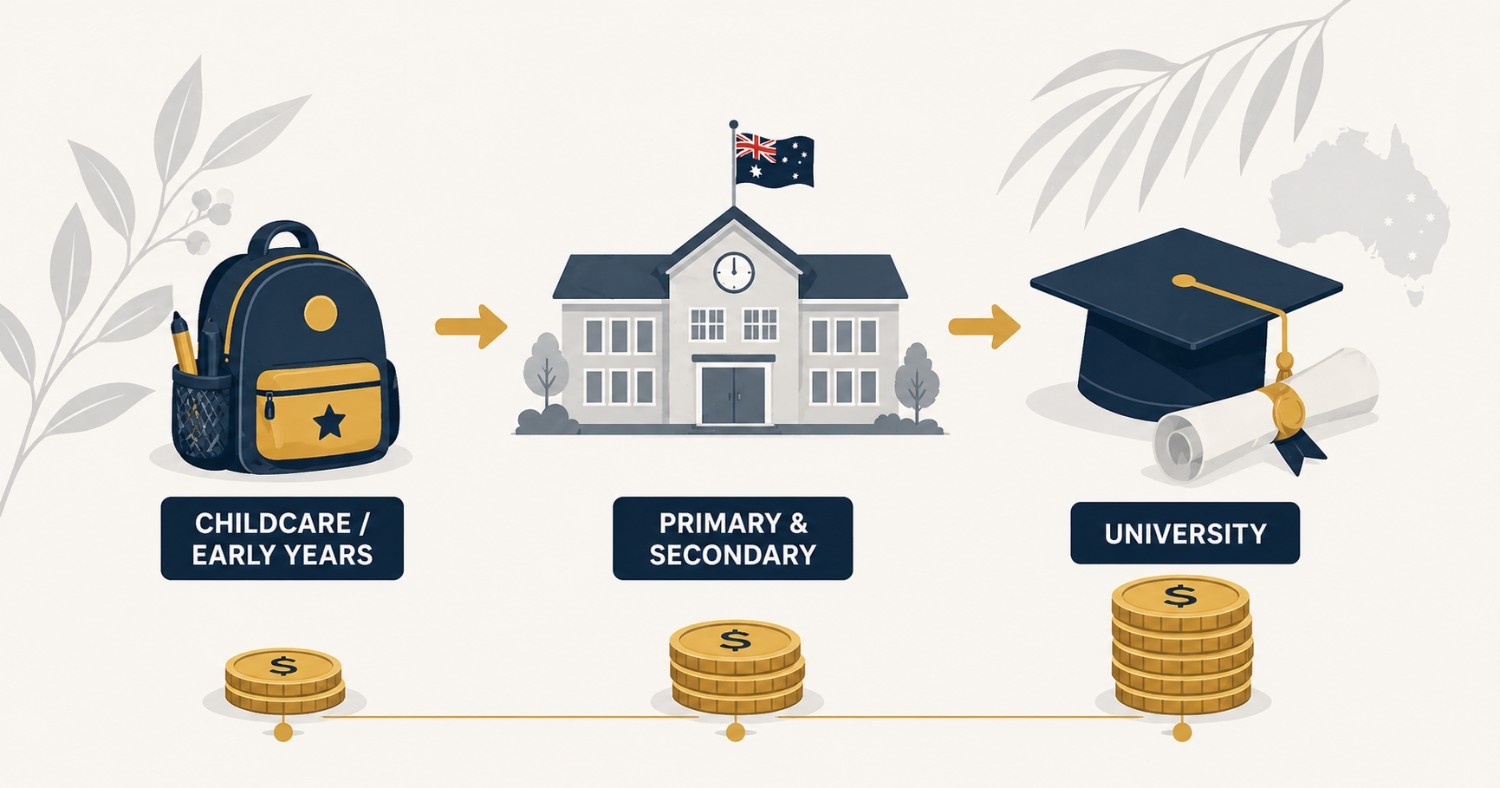
Education in Australia isn’t one bill – it’s a string of them, spread across roughly two decades from the first childcare drop-off to a uni graduation. And the rules change at every stage. People assume the public-versus-private split is the whole story, but it’s really about who carries the cost and when. At each stage, a different support system – childcare subsidy, school funding, HELP loans, study payments – sits on top and shaves down the family’s share. Once you see how the stages stack up, it makes sense why education feels expensive even though there’s a public option at every step.
The cost stages from early childhood to university
Education costs run through five broad stages:
- Early childhood (0-5) – childcare, kindergarten, preschool
- Primary and secondary schooling (5-18) – public, Catholic, or independent schools
- Vocational education and training (post-school) – TAFE and registered training organisations
- Higher education (university) – bachelor’s and postgraduate
- Continuing professional education – short courses, professional development
Every stage works differently, both in what it costs and in how the government helps. The federal Department of Education’s main portal handles the policy frameworks. StudyAssist covers the higher-education and VET loan side. Services Australia handles the payment side.
Here’s how those stages compare at a glance – all of it drawn straight from the sections below:
| Stage | Typical out-of-pocket cost | Main support mechanism |
|---|---|---|
| Early childhood (long day care) | $100-$200+ per day in published fees | Child Care Subsidy (CCS) |
| Public school | Hundreds to low thousands per year per child | State and federal school funding |
| Catholic / low-fee independent | A few thousand dollars per year | State and federal funding (plus fees) |
| High-fee independent | Tens of thousands per year for senior years | State and federal funding (plus fees) |
| VET / TAFE | A few hundred to a few thousand (subsidised) up to university-level (full-fee) | VET Student Loans; state subsidies / free TAFE |
| University | Student contribution amount, varies by discipline band | HECS-HELP, FEE-HELP, SA-HELP |
The childcare side gets its own deep dive in our aged and childcare costs article, which works through the Child Care Subsidy structure properly. Here, we’re after the bigger picture across all the stages.
Early childhood and childcare
For most families, early childhood costs come down to three things: long day care, family day care, and outside-school-hours care. Published hourly fees move around a lot, but long day care commonly lands somewhere between $100 and $200+ per day, depending on the city, the centre, and the standard of care.
The Child Care Subsidy (CCS) takes a real bite out of what families actually pay – but not evenly. Earn more and you get a smaller percentage back; earn less and you get a bigger one. On top of that, your family’s activity hours decide how many subsidised hours you can claim each fortnight. The full mechanics live in the aged-and-childcare article.
What CCS usually won’t cover:
- Pre-school programs operated by state government departments (which often have their own subsidy structures)
- Some specific or specialty programs
- Hours beyond the subsidy cap based on activity
Put two young kids in long day care and the gross fees climb into serious territory each year. The CCS brings that down, but it rarely wipes it out.
Public vs private school costs
School in Australia runs on three systems: public (run by the state, free at the point of use for most things), Catholic (low-fee independent), and independent (often higher-fee). Each carries a different cost profile.
Public schools
Public schools charge no tuition. But “free” still has a price tag. What families actually pay for each year usually covers:
- Uniforms and PE gear
- Stationery and devices (laptops/iPads, sometimes BYOD)
- Books and digital subscriptions
- Excursions and camps
- “Voluntary contributions” or building funds
- Music tuition, language tuition, and similar extras
Add it up and you’re typically looking at hundreds to low thousands of dollars per child each year, depending on the year level and what the school expects.
Private and Catholic schools
Catholic schools – the “low-fee independent” tier – generally charge a few thousand dollars a year in tuition. Independent schools at the top end, the “high-fee independent” or GPS-style ones, can run to tens of thousands a year by the senior years.
And tuition is only part of it. Private school costs also include building and capital levies, IT levies, uniform requirements, sport, and activities. The real total often sits well above the headline tuition figure.
One thing worth holding onto: every school, public and private alike, gets a mix of state and federal funding. Private school families pay their fees on top of that government contribution, not instead of it.
VET – vocational education and training
VET covers TAFE (run by the states) and private registered training organisations. Course fees are all over the map:
- State-subsidised places at TAFE (with eligibility based on residency, prior qualifications, and course type) – often a few hundred to a few thousand dollars for full courses
- Full-fee places – substantially higher, sometimes comparable to university per year
- Apprenticeship and traineeship arrangements – varied costs depending on the trade and employer arrangement
If you’re an eligible student at an approved provider, VET Student Loans can cover diploma and advanced diploma courses, much the same way FEE-HELP works for higher education. We unpack the eligibility framework in our HELP eligibility article.
For certain priority occupations and skills shortages, federal and state governments hand out fee subsidies or run “free TAFE” programs. These come and go with policy changes, so check the current list on your state TAFE site and on the federal education portal.
University – fees, places, and HELP
What university costs you hinges on two things: whether you’re in a Commonwealth-supported place (CSP) or a full-fee place, and which course-fee band your course falls into.
Commonwealth-supported places
In a CSP, the federal government pays part of the course cost straight to the university. You cover the rest – the “student contribution amount” – and that figure shifts with your course discipline. Broadly, arts and humanities sit at lower rates, law and commerce land in the middle, and science and engineering fall into another tier, with periodic policy changes shuffling which discipline ends up in which band. You can pay the student contribution upfront, or defer it through HECS-HELP.
Full-fee places
Full-fee students cover the entire course cost. For domestic full-fee places at approved providers, FEE-HELP picks that up as a deferred loan. International students generally can’t access HELP at all and pay full international fees upfront.
The loan mechanics themselves are in our HECS-HELP article, and the eligibility detail is in the HELP eligibility article. Read together, they cover the whole higher-education funding picture.
Course fees aren’t the end of it, either. University also brings:
- Student services and amenities fee (covered by SA-HELP)
- Textbooks (often digital), supplies
- Living costs – usually the biggest financial squeeze for students
Support payments and family interactions
A handful of Centrelink payments are built specifically for students and their families:
- Youth Allowance for students – for under-25 students meeting eligibility, including study load, age, residency, and (often) parental income tests for dependent students
- Austudy – for over-25 students in approved courses
- ABSTUDY – for Aboriginal and Torres Strait Islander students at all education levels
- Pensioner Education Supplement – for pension recipients undertaking study
- Family Tax Benefit B – applies to some families with dependent students
We cover who qualifies for these in our Centrelink eligibility article. For the most common student payment, the Youth Allowance for students page is the place to start.
The part that catches families out is the Family Income Test for dependent students under 22. The parents’ income shapes how much Youth Allowance the student gets – or whether they get anything at all. So a parental income test can quietly trim a student’s support, even when the student’s own situation would point to more.
What matters most, in order
If you’re trying to work out where to focus, here’s the priority order this guide points to – drawn entirely from the facts above:
- Plan across all stages, not one bill at a time. Modelling primary, secondary, and tertiary together changes the decisions you make.
- Know which support applies at your stage. CCS for childcare, school funding for school, HELP loans for tertiary, study payments through Centrelink.
- Look past the headline fee. “Free” public schooling and headline private tuition both hide extras – uniforms, levies, devices, camps.
- For uni, treat HELP as an income question, not an upfront-cost one. The deferred-repayment structure changes how you should think about it.
- Check the family income test before counting on student payments. Parental income can reduce Youth Allowance for dependent students under 22.
A worked example (illustrative only)
Illustrative only. Take a family with two young children in long day care. Using only the published figure from this article – $100 to $200+ per day – one child attending five days a week sits somewhere between $500 and $1,000+ per week in gross fees before any Child Care Subsidy. Two children in the same arrangement double that, landing roughly between $1,000 and $2,000+ per week gross. The CCS reduces those amounts based on family income and activity hours, but as noted above, it rarely eliminates them. These figures are a rough illustration of the published daily range, not a quote for any specific centre or family.
Frequently asked questions
Are public schools free in Australia?
Public schools in Australia don’t charge tuition fees, but families still pay for uniforms, books, devices, excursions, and voluntary contributions. The ‘voluntary contribution’ is technically optional but is the source of the gap between ‘free’ education and the real annual cost. Total public-school costs typically run into hundreds to low thousands of dollars per year per child.
How are private school fees structured in Australia?
Private school fees vary hugely — from a few thousand dollars per year for low-fee Catholic and independent schools to tens of thousands per year at high-fee independent schools. Fees usually include tuition plus building/capital levies, with extras for uniforms, IT, and activities. Most private schools also receive some federal and state government funding alongside fees.
What support payments help with study costs in Australia?
The main payments are Youth Allowance for Students (for under-25s), Austudy (for over-25s), ABSTUDY (for Aboriginal and Torres Strait Islander students), and Family Tax Benefit B (which can apply to families with dependent students). Eligibility depends on age, study load, family income, and dependence status. HELP loans cover course fees separately.
The single decision that affects total education cost most
Across the whole picture, the one decision that moves total family education spending the most isn’t picking a school or a course – it’s whether you fold education costs into your household’s long-run financial planning at all. Families who treat education as a multi-decade line in the budget – modelling primary, secondary, and tertiary stages as one continuous arc – make genuinely different calls on saving, schools, and timing than families who just deal with each stage as it lands on the doorstep.
If your kids are still young, run the numbers on the full arc using realistic estimates: current fees, an inflation assumption, the schooling pathway you expect. The total almost always comes out far higher than the current monthly bill makes it feel. The arithmetic isn’t fun. But it’s exactly what turns saving, school choices, and timing into strategic decisions instead of reactive ones.
For the tertiary stage in particular, the HELP system’s deferred repayments turn the question from “can I afford this now?” into “what will my income be later?” – which we dig into in our HECS-HELP article and the eligibility article linked above.